Books & literature

By Guus , 24 November 2012

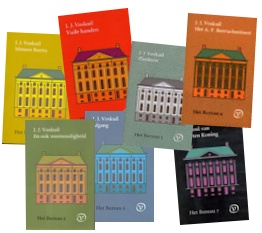
Het Bureau is a series of seven books that describes several decades of the life of Maarten Koning. It is an autobiographic book based on the career of the author J.J. Voskuil at the national research institute for Dutch language and culture.

I read the first book during my trip to Menlo Park and finished the final book a month later. I greatly enjoyed these books and it become one of my all-time favorite works. Het Bureau is a little like a "soap for intellectuals", describing the life and the career of an academic working on Dutch folk culture and mythology, and the bureaucratic entrails of a stuffy research institute that nobody takes very seriously.

The story is slow, but very carefully crafted. The people in the book involve into very rich characters. I enjoyed the descriptions of Amsterdam and the Dutch country side. Meneer Beerta has become one of my ever favorite characters in Dutch literature. The book is almost boring at times, but very addictive, and sometimes very funny -- the part about the “dorsflegel” was hilarious.

I especially enjoy reading about the board meetings (“de Commissie”). They are short but full of political intrigue. When I read about the interaction between Maarten and his subordinates, it makes my blood curl. They flat-out refuse the work assigned to them, undermine his work and pretend to be out sick all the time.

The book has a nostalgic mood occasionally. It is interesting to read how things were done in an office in the 1960’s. All letters, for example, were typed on a type-writer with overlays for the archive. It is interesting to see how cars get more and more common, and throughout the years more and more employees at Het Bureau get a car. The main character despises cars and doesn’t hesitate to make his opinion known.

The main character is not exactly an optimistic person. "Hij besefte plotseling hoe weinig er van het verleden was overgebleven en hoe uitzichtloos de toekomst was tegen de achtergtrond van de zich opstapelende, zinloze verantwoordelijkheden.” (“He realized how little of his past remained, and how pointless the future was against a background of steadily increasing but futile responsibilities”).
Maarten Koning is cynical about his profession and his fellow researchers.

“Maar ik maak geen indruk! Daarvoor praat ik veel te snel en veel te ingewikkeld. Als je indruk wilt maken, moet je wachten tot iedereen moe is, en dan moet je heel langzaam iets ontzettend banaals zeggen. Dat begrijpen ze en dat wordt het!”

“But I don’t make a strong impression! I speak too quickly and too complicated. If you want to make a good impression you should wait until everybody is tired, and then very slowly say something very mundane. That will be understood, and then implemented!”

Snobism

'Er komen daar natuurlijk allemaal natuurkundigen, chemici, biologen, geologen. Wat moeten die met de Nederlandse volkstaal en volkcultuur?' 'Dat interesseert ze juist!' zei Balk apodictisch. 'Eindelijk eens echte wetenschap!' - hij lachte met een grimmig sarcasme. Voor wat wij doen, heeft iedere intellectueel belangstelling. Dat geeft die bètamensen juist status! En anders prikkelt het het snobisme!' - hij glimlachte gemeen.

Balk is right about that, I greatly enjoyed reading about the scientific work that is being done in Het Bureau and how the ideas about the field change through the years. I subscribed to Quotidian, a new magazine about the study of everyday life.

When I was in high school I had heard about new parts of the book being published -- the publisher managed to stir up quite a hype around these books -- and it was a lot of fun to read old newspaper articles and interviews with characters from the book afterwards.

On a final note -- this is the quintessential Dutch book. If you want to understand more about Dutch culture and history, and your Dutch is fluent and you don't mind reading 5,500 pages... this is the book for you.
By Guus , 17 October 2012

Sasha pointed me to a glowing review in The Economist of a new book by Dutch author Herman Koch. The book hasn't yet been released in the U.S. but I read the Dutch version on my phone.

This book is a real page turner and the story captured me from the first chapter. The book is well written with very credible characters -- yet completely unpredictable.

By Guus , 19 August 2012

This book describes the current scientific understanding of how children learn a language in their first two years. It is a thorough book but very readable. It is a translation from a French book.

The book is full of fun facts:

  • Babies will babble in a lower pitch to their father than to their mother.
  • Babies at 8 to 9 months already have a feel for which words "sound right". American babies were less interested in Dutch words such as "zwetsen" and "vlakte" which contain "zw" and "vl" sounds that don't appear in English words.
  • Fairly early on, baby babbling will pick up the melody of the mother language. So French babies babble differently than American or Chinese babies, and adults can often tell what a baby's mother tongue is.

I was mostly interested in the developments during the first year, since Nora is now almost 6 months old. Still the remainder of the book was interesting as well, with several case studies of children in France and the USA and every child's language style.

The book is not primarily about dual language kids but the author enjoys pointing out the cultural differences between various countries. French children for example, know more food-words at an early age, Swedish kids more words for activities and American kids more nouns.

I picked this book when I went to the Arlington library with my parents.

By Guus , 4 July 2012

This is a collection of 3 short stories by Nescio, dating from the early 1900's. I loved the book.

There is a lot of analysis available in other places of the various themes in the book. For me the most powerful were the melancholic sadness and the beautiful descriptions of Holland in earlier times.

The book mainly describes the bourgeois class but also talks about to the lower classes and farmers ("de pummels"). Lovely, lovely!

This book was a gift to my parents, from November 15, 1991 when my father had broken his leg. He brought it to Arlington when he came to take care of Nora.

By admin , 20 May 2012

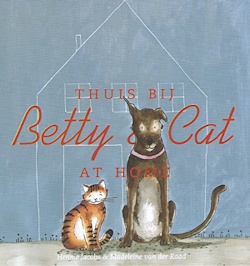
Thuis bij Betty & Cat At Home is a new book for bilingual children about the life of Betty, a Dutch-speaking dog, and Cat, who speaks English.

The book, written by Hennie Jacobs and illustrated by Madeleine van der Raad, was released in November last year and we received a review copy.

Targeting bilingual children -- and their relatives

Hennie Jacobs explains: "I originally targeted the book to grandparents, aunts and uncles of children being brought up bilingually - I thought they might feel left out of the bilingual experience, if their English wasn't so hot any more. It was meant to be read together. For example, one person taking on the role of the cat, the other the dog -- the book is not translated."

Hennie Jacobs herself became bilingual virtually overnight at the age of six as a Dutch immigrant to Montreal. An advertising copywriter, Hennie teaches English as a second language.

Betty and Cat really do exist, and the are the inspiration for the book. It is quite popular: "In fact, it turns out it's a big hit for mixed-language couples, in which the non-Dutch speaker may feel left out. We did a reading at The English Bookshop in Amsterdam in April, and that's who was there: mum's whose husbands are Dutch, whose kids are in Dutch schools, and who are learning Dutch. This book lets them participate, and builds confidence."

A review by 3-year old Stephanie

Stephanie, a bilingual 3-year old who we asked to do a review, greatly enjoyed the book. John, her father, explains: "Stephanie finished reading the book. It's a great concept, and it was fun to see how Betty the dog speaks Dutch and Cat English. The story is mainly about the difference between cats and dogs. Stephanie enjoys stories about animals, especially talking animals.

From my perspective as a father who is raising his daughter bilingually in an English-language environment, I noticed that Stephanie was a bit confused at first: normally I try hard to only speak Dutch with her and I make a point of always reading to her in Dutch. With that, switching language on every page was a little strange in the beginning. But in the same way as Dora Explorer (who speaks English and Spanish here in the U.S.), it turned out to be no problem at all for Stephanie."

Over-all, it's highly recommended, especially for parents of young polyglots!"

Plans for a series

The book is an easy read at 24 pages; subsequent books are meant to be 28 pages. Hennie says she is planning to write several more in the series: "There is a second written, In het Bos met Betty & Cat in the Forest, and a third, which I feel is a bit noir: Naar de Kennel met Betty & Cat in the Kennel."

Thuis bij Betty & Cat At Home
Hennie Jacobs and Madeleine van der Raad
November 2011
24 pages, $9.95 (shipping to the U.S.: $3.15)
http://www.bettyandcat.com/

Topic
By Guus , 7 April 2012

My experience with coming of age books has been rather mixed. I disliked A Catcher in the Rye and especially Portrait of the Artist as a Young Man. I borrowed this book from my parents because years ago I enjoyed another Vestdijk book a great deal. And indeed, Vestdijk managed to write a book about a 15 year boy that is touching, funny, and interesting.

By Guus , 4 April 2012

In my parent's house the to-be-returned library books were always on a specific shelf. Right above that were my parents' books, and "De Tweeling" always stood out. The book was published in 1990 so it clearly wasn't there throughout my whole childhood but in my memory the book was always there. It didn't appeal to me then to read it, but two years ago I bought a secondhand copy online.

This is a wonderful novel, and I greatly enjoyed it. It combines a traditional World War II story in the Netherlands with that of a woman growing up in Nazi Germany, and the book beautifully intertwines the life stories of the twins. The reader gets drawn into the story, and is intellectually curious to see how the author will wrap up the story, and emotionally curious to see how the women's lives will turn out.

Some parts of the book read like a boy's book about World War II, vaguely resembling Jan Terlouw's stories about the War in the Netherlands and the hunger winter, others parts are more about family relations and coming of age in difficult circumstances.

The book is also available in an English translation. Recommended.

By Guus , 30 March 2012

I have a list with classic books I want to read, and The Great Gatsby is one of the few that we own at home that I hadn't read. While waiting for Nora to wake up or fall asleep I often have a few minutes, and I found this book a perfect companion during those moments.

It is a very readable, entertaining story, and it drew me into a different world -- a great quality for a book. The book is "magic realistic", taking some liberties with basic chronology but wonderfully dreamy.

The edition I read came with a chapter on the history of the book, as well as an extensive explanation from the editor on how this text was derived (from the many drafts that the author wrote).

Sasha bought this book, and saw a ballet of The Great Gatsby last year in the Kennedy Center. I just found through Google that a new movie adaption will be released this year.

By Guus , 14 December 2011

I borrowed this book from the Arlington Library; a well-worn copy from 1997. The original edition is from 1969, and while I didn't realize it when I picked it up from the shelves, it is a well-known Christmas book that has even had exhibition in the Smithsonian around it. I enjoyed reading this book during the holidays, although it was not as interesting as the book on Thanksgiving I read in 2008.

The book explores the different traditions that immigrant groups have brought to America for Christmas. The Dutch Sinterklaas for the Santa Claus character (helped by a good dose of American creativity), the German "tannenbaum" tradition, eating turkey from the America's.

As a Dutch-American it was nice to read about the introduction of St. Nicholas to New York by Dutch settlers in the late 1600's, and how St. Nicholas merged with other figures into our current Santa Claus.

The book also contains a large amount of recipes. For me, the main text was more interesting. If anything, the recipes show that in all cultures winter celebrations are accompanied by copious amounts of found, often high in sugar and fat... and delicious.

It is striking to read how many different traditions and rituals exist. The culmination of this mixing bowl is the Christmas celebration in Hawaii.

For me personally, building rituals around the holidays and events is important -- preserving great memories from my childhood and mixing them with Bulgarian and American traditions. The book shows that this is the way it always goes: mixing and combining traditions have led to what we now consider "standard American Christmas" -- the same of course goes for other celebrations like Thanksgiving and birthdays etc. It's a strangely comforting feeling.

By Guus , 4 December 2011

This is one of the best books I've read in years, and certainly one of the most hopeful books.

Steven Pinkert convincingly makes the case that violence today, in all its forms, is at an historical low and has been on the decline throughout human history. Ranging from big stuff such as murder and torture, to smaller forms of violence as depicted in advertising in the 1950s, violence is clearly on the decline. This has huge implications for society and politics.

"The decline of violence may be the most significant and least appreciated development in the history of our species. The implications touch the core of our beliefs and values -- for what could be more fundamental than an understand of whether the human condition, over the course of its history, has gotten steadily better, steadily worse, or has not changed?"

The book's message resonates greatly with me: life nowadays is better than ever, and modernity is a force for the good, fueled by the ascent of reason. This is a very hopeful book.

The first part of the book, describing historical trends, is stronger than the second part where the author goes into detail on how the human minds works. A minor point of criticism is that some of his statements about more recent history, indicating that the US is becoming more liberal, seem a little premature, even though the long-term trend is probably correct.

I bought this book at the airport in San Francisco, traveling back from work.