March 2010

General apologizes for comments Dutch army

The Royal Netherlands Embassy wrote today that General John J. Sheehan has apologized to former Dutch Chief of Defence General Van den Breemen about his remarks on March 18 that related the Srebrenica massacre to gays serving in the Dutch armed forces.

Sheehan, a former NATO commander who retired from the military in 1997, was speaking at a public hearing in the Senate Armed Services Committee in opposition to a proposal to allow gays to serve openly in the U.S. military. An opinion article in the Los Angeles Times by Borris Dittrich, Dutch born director of Human Rights Watch described the exchange:

Homosexuals in the Dutch military had depleted the forces’ morale, he argued to the senators, and made them “ill-equipped to go to war.” And that was in part why they failed to prevent Bosnian Serbs from massacring more than 8,000 civilians in the former haven of Srebrenica in July 1995.

Sen. Carl Levin (D-Mich.) seemed incredulous at the testimony. “Did the Dutch leaders tell you it was because there were gay soldiers there?” he asked.

“Yes,” Sheehan said. “They included that as part of the problem.” He even claimed that the former Dutch commander of the U.N. peacekeeping force had told him this was true.

Earlier, Dutch prime minister Balkenende denounced the comments as “irresponsible” and said “these remarks should never have been made.” Ambassador Renée Jones-Bos issued a statement: “I heard the statements made by retired US General Sheehan in today’s public hearing in the Senate Armed Services Committee, in which he suggests a causal relationship between gays serving in the Dutch military forces and the massacre of Srebrenica. I couldn’t disagree more.

I take pride in the fact that lesbians and gays have served openly and with distinction in the Dutch military forces for decades, such as in Afghanistan at the moment.

The military mission of Dutch UN soldiers at Srebrenica has been exhaustively studied and evaluated, nationally and internationally. There is nothing in these reports that suggests any relationship between gays serving in the military and the mass murder of Bosnian Muslims.”

In today’s letter, Sheehan wrote: “I am sorry that my recent public recollection … 15 years ago inaccurately reflected your thinking on some specific social issues in the military”.

Gays have been allowed to serve in the Dutch army since 1974.
Dutch designers in Washington DC gallery

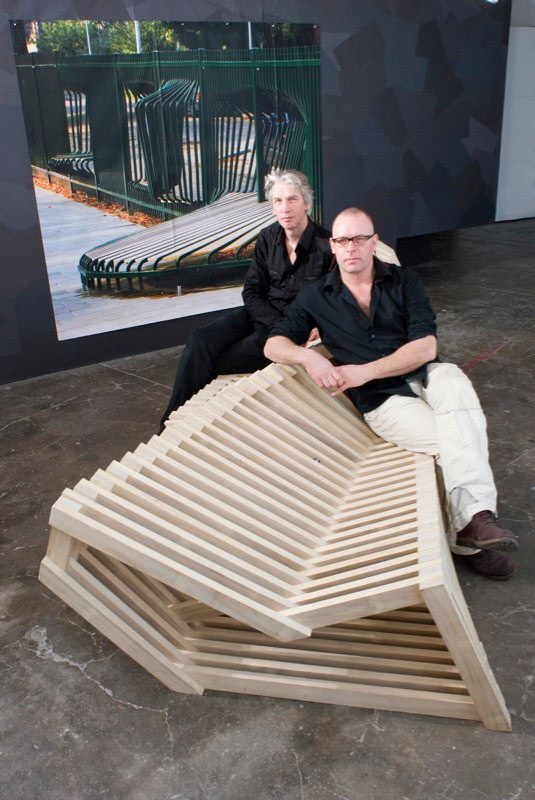
Remy and Veenhuizen.The Washington Post writes today about an exhibition by Dutch designers Tejo Remy and René Veenhuizen in the Industry Gallery in Washington DC.

This is the first American solo exhibition for Mr. Remy, 20 years after he launched the radical idea of recycling-as-fine-design. Since 2000, all of Remy's works have been done in collaboration with Mr. Veenhuizen.

The Washington Post:

People often use words like "whimsical," "comic" or "witty" to describe the works of Remy and Veenhuizen, but the laughter they provoke is usually nervous, more like a response to Lenny Bruce than to Mickey Mouse. "For us, it's dead serious," Veenhuizen says, smiling. "It's not humor for humor's sake," says Remy, more soberly. "Good humor is very intellectual."

Almost all of us still associate design with "comfort" -- if not physical, then at least intellectual or aesthetic. Even if a Bauhaus armchair in chrome and leather may not be easy on the bottom, it is easy on the eyes and has such a get-able gestalt that we can learn to be at ease with it. Even most avant-garde designers have come up with new models for comfort and ease -- turning away from Victorian velvet-on-oak, for instance, to embrace Bauhaus, then Danish modern. What few designers have done is work to abolish comfort itself as a design principle, in favor of objects that disconcert. That's the Remy and Veenhuizen model.

Exhibition Tejo Remy & Rene Veenhuizen
March 20 through May 8
Industry Gallery, Washington, DC
http://www.industrygallerydc.com/Site/Upcoming.html

New paintings in Holland, MI

Adriaen Brouwer.The Holland Museum in Holland, Michigan, houses an extensive collection of Dutch paintings. The Dutch Galleries of the Museum showcases many 17th to 20th century Dutch paintings and more than one hundred and seventy other cultural objects, from fine furniture, Delftware and silver to original Dutch costumes
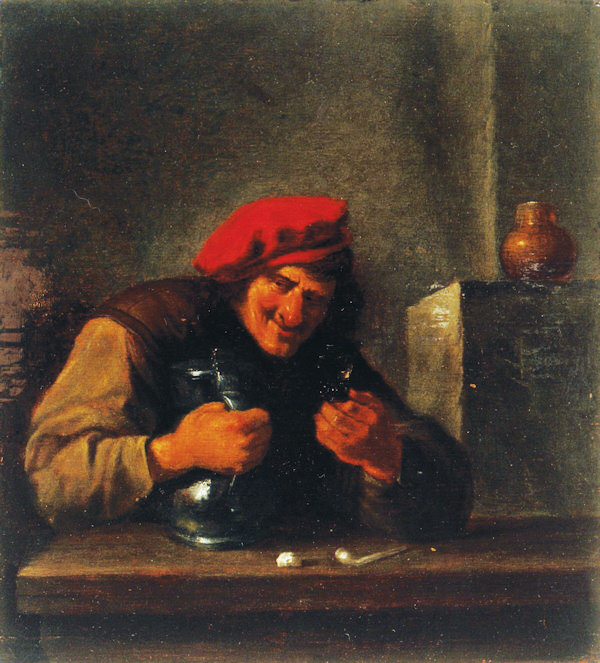
Tomorrow, March 27th, two new paintings will added to the Galleries. One is a Willem Kalf kitchen still life, and the other is an untitled work, referred to internally as ‘The Drinking Man’, attributed to Adriaen Brouwer.

To celebrate the addition of the paintings a local author created a brief play inspired by these and other paintings in the Gallery. The play and “Dutch Art Comes Alive” event make up the ceremony around these two paintings being added to the gallery. The museum will have a a reception that day as well. Thea Grigsby, the Executive Director, is the resident Dutch art expert and will provide some insight into the paintings in the form of a short talk.

The Adriaen Brouwer was donated to the Museum by Eleanor DeKruif from Zeeland (wife of noted microbiologist Paul DeKruif); the Willem Kalf was donated by the Beekhuis Foundation. The paintings are not new to the museum — the Adriaen Brouwer was donated in 1979 — but this is the first time the works go on display.

Holland Museum
Holland, Michigan
http://hollandmuseum.org

Frans Hals reunited in Connecticut

An art exhibition in Hartford, Connecticut temporary reunites two works of Frans Hals and other pairs of paintings. The show, “Reunited Masterpieces”, displays 10 pairs of paintings that were originally created together but over time were sold to different collectors and museums. The intimate exhibition is worth a visit to the Wadsworth Atheneum. Three of the pairs on display are by Dutch painters.

The works by Frans Hals are portraits of Joseph Coymans and his wife, Dorothea Berck; he was 52, she 51 when works were created in 1644. His portrait belongs to the Wadsworth, while her’s traveled north from the Baltimore Museum of Art to join him. The two have been reunited only once before, in a show in Hals’ hometown, Haarlem, the Netherlands, in 1962.

The Wadsworth Atheneum acquired a painting of Adam by Hendrick Goltzius (1558-1617) in 2004. The corresponding Eve belongs to the Musée des Beaux-Arts in Strasbourg, France. A New York Times review describes the differences between the two paintings:

“Some of the paintings in the pairs appear extremely different, partly because of different conservation methods, Dr. Zafran, the curator, explained. The portrait of Adam remains fresh, pink and luminous, while Eve appears older and more weathered, with a light coating of grime and crackling on the surface.”

A third pair of Dutch paintings, with very elaborate frames, is of the hand of Johannes Verkolje de Elder. His 1674 portraits of Johan de la Faille and his wife Margaretha Delff both belong to the Wadsworth. Shortly after the museum bought Johan’s portrait in 1982 it became aware of the accompanying painting of his wife and purchased it a year later.

The permanent collection of Wadsforth Atheneum contains several other Dutch works including a Rembrandt and Ruysdael’s “View on Bloemendaal”.

Reunited Masterpieces
February 14 through May 30, 2010
Wadsworth Atheneum, Hartford, CT
http://www.wadsworthatheneum.org

Registration form Dutch elections now available

Voting registration form.The registration form for Dutch citizens abroad who want to participate in the upcoming parliamentary elections in the Netherlands is now available.

The completed voter registration form should be sent to the municipality of The Hague, the Royal Netherlands Embassy in Washington, D.C. or one of the Dutch Consulates General (New York, Chicago, Miami or San Francisco). A proof of Dutch citizenship needs be included. All materials need to be received by April 27th.

The actual voting can be done via mail, by proxy, or, if you happen to be visiting the Netherlands, in person. There won’t be any voting via internet. Note that the voting documents may not be sent until May 21st and votes need to be received in the Netherlands on June 9. Since 19 days for a round-trip via mail is rather short, voting by proxy may be the safest approach to get your vote counted.

The Royal Netherlands Embassy has the most recent information. More details on the procedure can be found here (in Dutch), by phone at +31 70 353 4488 or via e-mail at verkiezingen@dbz.denhaag.nl.

Elections for Dutch parliament (Tweede Kamer) will be held on June 9. The previous cabinet fell when the Labor Party (PvdA) quit the government because it could not agree with the Christian Democrats (CDA) to extend the service of 2,000 Dutch troops in Afghanistan’s Uruzgan province.

Winter Landscapes by Hendrick Avercamp at the National Gallery of Art

Hendrick Avercamp.An exhibition with winter landscapes by Hendrick Avercamp will open this Sunday in the National Gallery of Art in Washington, DC.

Hendrick Avercamp (1585 – 1634) is generally considered the greatest winter landscape artist of the Dutch Golden Age; this exhibition features 30 of his finest works.

“The Little Ice Age” was very popular in Amsterdam where it drew large crowds. Appropriately, the exhibition was on display during one of the coldest winters in the Netherlands in many years. As the Dutch newspaper Het Parool put it, “an art exhibition couldn’t be any more topical”. A selection of 17th-century Dutch ice skates will also be on view.

“Quintessential representations of 17th-century Holland”

“Avercamp’s images capture a timeless quality that resonates to this day, making his winter landscapes quintessential representations of 17th-century Holland,” said Earl A. Powell III, director, National Gallery of Art. “We are grateful to the museums and private collectors in Europe and the United States who graciously agreed to lend their delicate Avercamp paintings and drawings for the exhibition.”

Hendrick Avercamp was born in Amsterdam, but he lived and worked in Kampen, far removed from the artistic centers of Amsterdam and Haarlem. He was known to contemporaries as the “Stomme van Kampen” (Mute of Kampen), for he was not able to speak and was possibly deaf. He had a sharp eye for visual anecdote and —-although he painted in a style that reflected the 16th-century pictorial traditions of winter scenes by Pieter Bruegel the Elder—- his cast of characters and their activities became the primary focus of his work. Avercamp was the first artist to specialize in winter landscapes that feature people enjoying themselves on the ice, thus making the “ice scene” a genre in its own right.

Avercamp’s paintings and drawings will be shown in the intimate Dutch Cabinet Galleries. On Friday March 19 Dutch skate collector Anrie Broere will give a public lecture; on the opening day of the exhibition Pieter Roelofs, curator of 17th-century paintings, and Bianca M. du Mortier, curator of costume, Rijksmuseum will speak.

Hendrick Avercamp: The Little Ice Age
March 21 through July 5, 2010
National Gallery of Art, Washington, DC
http://www.nga.gov

Dutch street organ in New Jersey

How a Dutch immigrant brought European music and style to New Jersey.

Johanna Vander Heijden.Many Dutch immigrants to the United States bring with them memories and items from home. Few will bring a 2,600 pound, car-sized street organ, as Johanna Vander Heijden did. Here is her story.

Dutch immigrants

In the Netherlands Mrs. Vander Heijden and her husband Ton lived on a farmhouse from the 1780’s in Pijnacker and they shared a love for antiques. Pijnacker is a town near Delft, in Zuid-Holland. Mrs. Vander Heijden: “This is Holland at its best, between the two major cities The Hague and Rotterdam. I still miss it!” They collected many French antiques and decorated their home with them.

Mr. Vander Heijden, an engineer, worked for an American company and in 1984 they moved with their daughter Monique to the United States. “I had said I would follow him wherever, but I didn’t realize he was serious about moving to the States”. After they arrived in the U.S. they lived in Parsipany, NJ for two years. When they moved to Buttzville, New Jersey two year later, Mrs. Vander Heijden opened her boutique Showtime in Belvidere, NJ. They transported their French antiques for their home and the boutique and decorated the interiors in a beautiful style.

Music and a meatball with a slice of white bread

“My family played the button accordion (“knopjes accordeon”) in cafe’s at the Noordplein in Rotterdam: my grandfather before World War II and my sister Cobie until the late 1960s. When she was a kid she would play on Sunday afternoon in cafe’s in Rotterdam. The payment was a meatball with a slice of white bread. I was too little to join, but nowadays I frequently play at events. And of course, on request I’ll play in Showtime when we have an event, for example the French musette.” Mrs. Vander Heijden’s daughter Monique continues the musical tradition and is a music manager for songwriter Gar Francis.

“There was always music in my family, and we had to learn the accordeon. I’m still grateful to my grandfather (opa) that he took the time and patience to teach his granddaughters that very difficult instrument. When I play ‘De Kast’ at Showtimes’ events I always think of that.” Mrs. Vander Heijden: “A button accordion is totally different than a piano keyboard. The buttons on both sides makes it very hard to learn. The sound of an accordion is very similar to a street organ, which is one of the reasons we bought one.”

In 1993 Vander Heijden went looking to purchase a street organ in Holland as a birthday present for her husband, who loved the “big organ sound”. They met Gerhardt Roos, a craftsman who had restored an old street organ.

Mrs. Vander Heijden: “During World War II there were no street organs at all. The Nazi’s were confiscating them so the Dutch people took them apart and hid them. After the war, people knew the war was over because the street organs came back onto the streets.” Violanta, however, became the “forgotten street organ” and remained in various hiding places for 35 years before Mr. Roos found it and started working on it. “It took him many years to find all the pieces and put them together,” Mrs. Vander Heijden explained.

After long negotiations, Mr. Roos agreed to sell the organ to the Vander Heijden’s when he found out it would go to the United States. The couple had the delicate piece crated and shipped by boat to Philadelphia.

Draaiorgel in New Jersey

A typical street organ in Holland is mounted on a cart and pushed through the city streets where the operator stops and plays for donations. Vander Heijden’s street organ, called Violanta, which means “little powerful”, was built in 1920. The large organ was originally used to play music at summer festivals and was pushed along streets in the spring, fall and wintertime. “Every town had a street organ. It was very fashionable,” Mrs. Vander Heijden explained. “They would push it through the streets.”

The organ has 68 wooden pipes, drums, cymbals, violins, flutes, large bellows, and castanets. The exterior is decorated a scene depicting Holland’s green pastures and lakes. Two beautiful gypsy girls look out at listeners from either side. Dominating the center of the piece is a mechanical conductor whose arms move up and down in time to the music. Traditionally vendors would manually crank the organs for hours on end but the Violanta’s music is run mechanically with a motor.

The books of music are “read” by the organ like a player piano and range in pieces from American to classical and European. Since each street organ is different, books are made to order. A few months ago Mrs. Vander Heijden was in the Netherlands and had a new book made, “Painted Black” by the Rolling Stones.

The Violanta is often on the road, for example at the annual Belvidere Victorian Days and the Sinterklaas celebration at the Van Wickle House in Somerset, New Jersey. Johanna loves to play music: “Children dance, and adults are emotionally touched. I always see a smile on people’s faces when they stop to admire the organ. It’s really quite something.”

The Violanta even made Dutch national TV when the Mrs. Vander Heijden was on Wall Street when a major bank went public in 1997 and she rang the bell. Recently the street organ participated in the NY400 celebrations in New York City. Two CDs with the street organ were created as well, “Street Organ, The Violanta”, each over 60 minutes of great recordings of songs such as “Amsterdam Medley”, “Klein Cafe” and “Greeting to Breda”.

Violanta, Inc.,
472 Rt. 46 West
Belvidere NJ 07823
Telephone: 908-453-3111
Violanta: http://www.myspace.com/violantastreetorgan
Showtime: http://www.myspace.com/showtime46

Excavated Dutch artifacts on display

The New York Transit Museum is opening an exhibit featuring many Dutch artifacts dating back to the 1600s. The exhibit entitled “Where New York Began: Archeology at the South Ferry Terminal” will be on public display in the museum’s Annex in Grand Central Terminal from March 18, 2010 through July 5, 2010.

“This exhibition is an exciting opportunity for the Museum to bring the early city alive through small fragments illustrating color and textures of the New Amsterdam”, says Mrs. Amash, curator of the museum. “It is especially interesting during the period after the Dutch had lost control of the city to the British, but New York’s ‘Dutchness’ remained evident physically and culturally.”

Before constructing the new South Ferry subway station an extensive archeological dig was conducted on the site, and two 18th century city landmarks - four sections of the Battery Wall and portions of Whitehall Slip - were uncovered, along with 65,000 artifacts. This exhibit in mid-town Manhattan will feature over 100 artifacts, documents and images of these discoveries, including many with a Dutch history.

“A big exhibit for us”

Ms. Robertson, Director, Special Projects of the museum: “This is a big exhibit for us. Very rarely do we get to experience or present exhibits with a strong international tie-in.” Among the most important finds of the excavation were pieces of two 18th century landmarks— the Battery Wall and Whitehall Slip. Stones from the Wall are on view, as are photographs of a section of the Wall that was reinstalled in the new South Ferry station.

Pipes from Amsterdam and Gouda

Many of the 17th century pipes found on the site can be traced to manufacturers in Amsterdam and Gouda based on their makers’ marks. Three lettered initials were common marks used on early Dutch pipes. Research from other New York digs suggests that “MTS” was owned by English-born Matthias Stafford working in Amsterdam. Some marks were passed down through generations of a family, such as the “hand” mark on a pipe here that was passed down through various De Vriendt family members for 63 years. Other marks were bought and sold or rented by local pipemakers, such as the three-leaf clover mark exchanged between dozens of pipemakers between 1660 and 1840.

More than 1,470 fragments of clay tobacco pipes were found on the project site. Though pipes are utilitarian objects, their design, decoration, and makers’ marks can be seen as icons for the brief period of time in which each was manufactured and used. Many of the pipes uncovered at South Ferry were English or Dutch made and showed signs of use. These often intricately decorated pieces are very small, making their discovery during a large dig all the more remarkable.

Personal items

Scattered among the thousands of objects in the landfill deposits are a handful that are clearly personal. A small glass bottle seal with the (possible) arms of Governor Benjamin Fletcher (circa 1690-1700) is the only object that can be attributed to a specific individual. The wine bottle seal’s motif suggests it belonged to Fletcher, New York’s governor from 1692-1697. A medal commemorating the taking of the Fortress of Louisbourg by the British in 1758 is a shoddily made copy of one commemorating the July 1758 British capture of the French Fortress of Louisbourg on Nova Scotia. Shoe buckles made of copper alloy from the 1700s, buttons from Revolutionary War-era uniforms, and the inner and outer layers of 18th century shoe soles are also on view.

Where New York Began: Archeology at the South Ferry Terminal
March 18, 2010 through July 5, 2010.
New York Transit Museum’s Annex, Grand Central Terminal, NYC
http://mta.info/mta/museum/index.html

U.S. Census 2010 starting soon

Dutch Gids voor Taalhulp for the U.S. Census 2010.Census forms will be sent to every household the United States in the next weeks. Unlike previous years there will be no separate questions on language or heritage, so there’s no opportunity to mark “Dutch” on the form for those Dutch-Americans eager to indicate their heritage.

The 2010 Census aims to count all U.S. residents — citizens and non-citizens alike. It helps to determine how more than $400 billion dollars of federal funding each year is spent on infrastructure and services.

In 2000 there were two forms, a short form and a longer form that one in every 6 households would receive. This is no longer the case; the long form has been replaced by the continuous American Community Survey. In 2004 this survey found that an estimated 5 million people in the U.S. are of Dutch descent. Incidentally, Statistics Netherlands (CBS) estimates that more than 31,000 Americans live in the Netherlands.

The 2010 census has a Dutch translation of the 10 questions on the form in a Gids voor Taalhulp (Language Assistance Guide).

Dutch Art Now 2010, pictures

Dutch Art Now 2010, picturesAs we wrote earlier, this week is the Dutch Art Now art fair in New York City. On Friday evening there was a party at the National Arts Club which drew a large crowd of art lovers.

Click on ‘Read more’ for pictures of the evening.

Popular content