By admin , 29 November 2012

Nora has been sleeping well but we woke up at 6.15 am which is a little early for us. So I was pretty tired during this run, although it went well.

By Guus , 29 November 2012

Books I'd like to read, from various lists:

http://blog.patrickrothfuss.com/2011/06/fanmail-faq-looking-for-good-bo…

Individual books:

  • Silk Road by Frankopan
  • Bono Memoirs -- Surrender
  • The Screwtape Letters
  • Embarrassement of Riches, Schama
  • The Wealth and Poverty of Nations
  • A book by Neil deGrasse Tyson, not sure yet which one
  • https://en.wikipedia.org/wiki/The_Magic_Mountain
  • History-Western-Philosophy-Bertrand-Russell

Books I've read to the kids: voorlezen.

By Guus , 29 November 2012

Here's another list of Dutch books that I'd like to read:

  • 2022: Yvonne Keuls, Mevrouw mijn moeder
  • 2021: Adriaan van Dis, De wandelaar (January 2023)
  • 2020: Judith Koelemeijer, Het zwijgen van Maria Zachea (January 2023)
  • 2019: Jan Wolkers, Winterbloei
  • 2018: Je bent wat je leest, verschillende schrijvers
  • 2017: Isaac Asimov, I, Robot and De robot van de Machine is de mens - Ronald Giphart
  • 2016: Morten - Anna Levander, Heer van de vliegen - William Golding, Liefde en schaduw - Isabel Allende
  • (February 2023)

  • 2015: A.L. Snijders, Nederland leest de mooiste korte verhalen (February 2023)
  • 2014: Maarten 't Hart, Een vlucht regenwulpen (in progress)
  • 2013: Godfried Bomans, Erik of het klein insectenboek (September 2022)
  • 2012: W.F. Hermans, De donkere kamer van Damokles (November 2012)
  • 2011: Remco Campert, Het leven is vurrukkulluk (January 2023)
  • 2010: Jacoba van Velde, De grote zaal (December 2012)
  • 2009: Hella S. Haasse, Oeroeg (January 2023)
  • 2008: Harry Mulisch, Twee vrouwen (December 2010)
  • 2007: Theo Thijssen, De gelukkige klas (read in 2012, loved the book. Didn't write a book review)
  • 2006: Frank Martinus Arion, Dubbelspel (January 2023)
By admin , 28 November 2012

I want to run at least the same amount of miles this year as I did in 2010. That means that after yesterday's run there are 26 more miles to go -- a marathon. Shouldn't be a problem in a normal month but December is always very difficult, mileage wise.

By Guus , 26 November 2012

This book about dementia made me sad. It was often painful to read but it is a beautiful work.

Maarten Klein, the main character, grew up in the Netherlands and thinks back to his childhood and early years in the northern part of North-Holland, near where I was born. He now lives an hour outside of Boston with his long-time wife Vera.

Maarten suffers from Alzheimer's disease and he is slowly losing his mind. The first-person perspective show how invasive the disease is. Through flashbacks and lost-and-then-found memories we learn about his life, his relation with Vera and the impact of the disease on their relationship.

Painstakingly beautiful.

By admin , 25 November 2012

In 2007 an internet-based poll resulted in a top 10 of most popular Dutch books "of all times". It gives a good snapshot of popular books and I decided to read all the books on the list.

On this page I maintain an overview of them, with a link to a short review for the ones that I've read.

  1. Harry Mulisch, De ontdekking van de hemel (1992)
  2. Kader Abdolah, Het huis van de moskee (2019)
  3. Multatuli, Max Havelaar (didn't finish it)
  4. J. Bernlef, Hersenschimmen (November 2012)
  5. W.F. Hermans, De donkere kamer van Damokles (November 2012)
  6. W.F. Hermans, Nooit meer slapen (December 2012)
  7. J.J. Voskuil, Het bureau (November 2012)
  8. Nescio, De uitvreter, Titaantjes, Dichtertje (July 2012)
  9. Gerard Reve, De avonden (December 2012)
  10. Thomas Rosenboom, Publieke werken (January 2023)
By Guus , 25 November 2012

After finishing Het Bureau I fell into a deep hole, literature wise, and needed another "fix". I had never read anything from W.F. Hermans so I read this book, his most famous work.

I don't read reviews or background articles before I start a book, since I like to make up my own mind and to be surprised by the story. This is one of those books where it is especially important not to know anything about the plot.

Almost to my surprise, I greatly enjoyed this book. I was skeptical after the first 10 pages but the book became a real page-turner. I understand why this is such a popular novel.

I am looking forward to read Herman's next book on my list, Nooit meer slapen (Beyond sleep).

By admin , 25 November 2012

I didn't really feel like running today. It is cold and I'd have preferred to stay inside. But after Thanksgiving it is important to maintain momentum, and my target goal of running 358 miles this year is a great motivator (34 more miles to go as of before this run).

So I put on my jacket and went anyway and allowed myself a simple run -- 4 miles, no more. It felt sluggish the first half, and never really felt fast, but when I was done I saw I ran a nice time.

By Guus , 24 November 2012

Het Bureau is a series of seven books that describes several decades of the life of Maarten Koning. It is an autobiographic book based on the career of the author J.J. Voskuil at the national research institute for Dutch language and culture.

I read the first book during my trip to Menlo Park and finished the final book a month later. I greatly enjoyed these books and it become one of my all-time favorite works. Het Bureau is a little like a "soap for intellectuals", describing the life and the career of an academic working on Dutch folk culture and mythology, and the bureaucratic entrails of a stuffy research institute that nobody takes very seriously.

The story is slow, but very carefully crafted. The people in the book involve into very rich characters. I enjoyed the descriptions of Amsterdam and the Dutch country side. Meneer Beerta has become one of my ever favorite characters in Dutch literature. The book is almost boring at times, but very addictive, and sometimes very funny -- the part about the “dorsflegel” was hilarious.

I especially enjoy reading about the board meetings (“de Commissie”). They are short but full of political intrigue. When I read about the interaction between Maarten and his subordinates, it makes my blood curl. They flat-out refuse the work assigned to them, undermine his work and pretend to be out sick all the time.

The book has a nostalgic mood occasionally. It is interesting to read how things were done in an office in the 1960’s. All letters, for example, were typed on a type-writer with overlays for the archive. It is interesting to see how cars get more and more common, and throughout the years more and more employees at Het Bureau get a car. The main character despises cars and doesn’t hesitate to make his opinion known.

The main character is not exactly an optimistic person. "Hij besefte plotseling hoe weinig er van het verleden was overgebleven en hoe uitzichtloos de toekomst was tegen de achtergtrond van de zich opstapelende, zinloze verantwoordelijkheden.” (“He realized how little of his past remained, and how pointless the future was against a background of steadily increasing but futile responsibilities”).
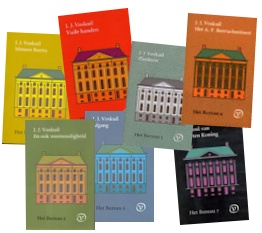
Maarten Koning is cynical about his profession and his fellow researchers.

“Maar ik maak geen indruk! Daarvoor praat ik veel te snel en veel te ingewikkeld. Als je indruk wilt maken, moet je wachten tot iedereen moe is, en dan moet je heel langzaam iets ontzettend banaals zeggen. Dat begrijpen ze en dat wordt het!”

“But I don’t make a strong impression! I speak too quickly and too complicated. If you want to make a good impression you should wait until everybody is tired, and then very slowly say something very mundane. That will be understood, and then implemented!”

Snobism

'Er komen daar natuurlijk allemaal natuurkundigen, chemici, biologen, geologen. Wat moeten die met de Nederlandse volkstaal en volkcultuur?' 'Dat interesseert ze juist!' zei Balk apodictisch. 'Eindelijk eens echte wetenschap!' - hij lachte met een grimmig sarcasme. Voor wat wij doen, heeft iedere intellectueel belangstelling. Dat geeft die bètamensen juist status! En anders prikkelt het het snobisme!' - hij glimlachte gemeen.

Balk is right about that, I greatly enjoyed reading about the scientific work that is being done in Het Bureau and how the ideas about the field change through the years. I subscribed to Quotidian, a new magazine about the study of everyday life.

When I was in high school I had heard about new parts of the book being published -- the publisher managed to stir up quite a hype around these books -- and it was a lot of fun to read old newspaper articles and interviews with characters from the book afterwards.

On a final note -- this is the quintessential Dutch book. If you want to understand more about Dutch culture and history, and your Dutch is fluent and you don't mind reading 5,500 pages... this is the book for you.