The Old First Reformed Church of Brooklyn organized a Dutch service and dinner on Sunday November 15. The event was part of the 5 Dutch Days in New York City. The church, affectionately called "Old First", dates back to 1654 when what is now New York was still New Amsterdam. Until 1824 services were held in Dutch.
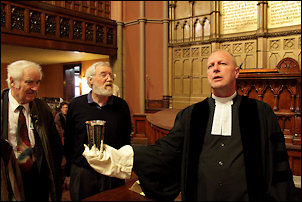 Pastor Meeter welcomed us before the service and gave a tour of the historical building. "Heel goed" and "uitstekend" were the first Dutch words from the New Jersey born pastor, who speaks Dutch well and has a slight Frisian-Gronings accent. He explained that he learned Dutch from his grandparents and that he studied a few months in Groningen, the Netherlands. His PhD dissertation studied the English translations of Dutch liturgy.
The stained-glass windows of the Old First building carry the names of influential New York families of Dutch descent such as Suydam, Cortelyou and Schenk. The organ is a 1891 Roosevelt organ, made by cousins of 'Teddy'.
Geliefde gemeente, dames en heren, mensen en kinderen
Paster Meeter started his sermon with a greeting in Dutch: "Geliefde gemeente, dames en heren, mensen en kinderen."
The service incorporated many Dutch elements. The 15 children in the choir were dressed in old Dutch costumes and sang three Psalms in Dutch -- quite impressive. During the service Pastor Meeter talked about the history of the church: throughout its existence the congregation has had five buildings at three different locations. At its peak Old First had 1,000 members. In 1792 the church added an English language service and until 1824 the church used the Statenvertaling, the first official Dutch translation of the Bible.
During the sermon the pastor asked: "Why does our church participate in 5 Dutch Days? For many of the same reasons that school or a museum or a gallery or consulate would do this: knowledge, relationships, fun... but the driving motivation is love, The Love of God."
 Avondmaal bekers
The church owns two antique communion cups (avondmaal bekers), crafted in 1684. Pastor Meeter showed us one of them; the other is on display in a museum in New York. The service was attended by around 130 people.
Dutch without potatoes
Dinner was served after the sermon. "Dinner" is used in its original meaning: the first meal of the day, eaten about noon. A team of many volunteers worked for two days to prepare the meal.
Ken Nieuwenhuis, a third generation Dutch-American, developed the menu and managed the kitchen. His grandfather immigrated from Noord-Holland to set up an American branch of a tulip export company in Wyckoff, NJ.
Ken knows Dutch food well: "This is what I grew up with. When I was first thinking of the menu I thought it would be fairly easy: just boil a large amount of potatoes and make a Dutch stamppot or two. But then I realized: no potatoes! The potato was not known to the Dutch colonists in New Netherland at the time. We tried to cook the food as it was done in New Netherland and with ingredients available in the 1600's. We used Peter Rose's historic cookbook 'The Sensible Cook' for guidance."
"The dishes had a lot of Dutch cultural influences, but also incorporated what we knew the colonists appropriated from the native Americans, which is why there was a corn meal based bread pudding on the table, and pancakes with pumpkin mash. I also tried to stick with fall vegetables such as cabbage, carrots, beets, onions, celeriac and squash (another New World staple), and with foods that the colonists would also likely have preserved, such as dried peas and smoked metworst. Interestingly, spices such as nutmeg and pepper were available in the 1600's, due to the Dutch spice trading".
Ken: "My favorite dish? The rabbit."
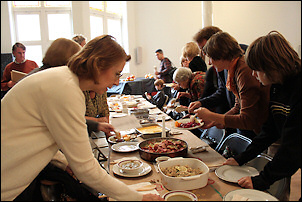 The meal was served and eaten with large wooden spoons. Dishes included:
- Peasoup with carrots and ham
- Metworst with cabbage
- Stewed rabbit
- Rodekool (red cabbage)
- The desserts included a boter letter, Dutch apple pie and home-made speculaas
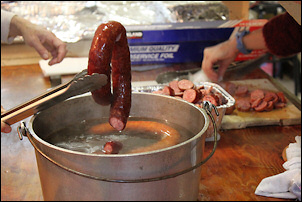
The highlights of the dinner for a number of first generation Dutch-Americans we spoke with were the stewed rabbit and the sauerkraut with authentic metworst. Good metworst is hard to find in the United States and this was the real thing. Metworst is more flavorful than Polish kielbasa and coarser consistency. Ken Nieuwenhuis shared with us the secret of the sausage: it's from the Market Basket, a specialty store in Franklin Lakes, New Jersey.
Over a 100 guests attended the dinner, which was a great success thanks to hard work by the staff and many friendly volunteers.
Old First Reformed Church of Brooklyn
http://www.oldfirstbrooklyn.org
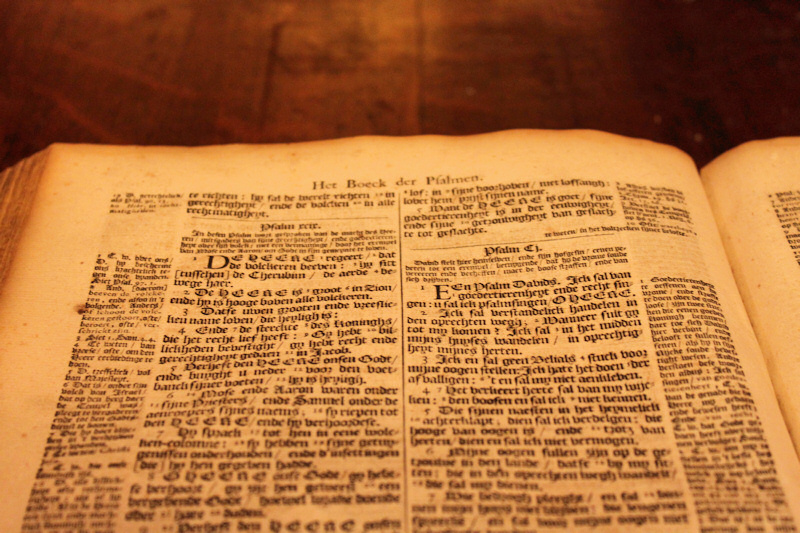
A Dutch bible in the church. Until 1824 services in the church were held in Dutch.
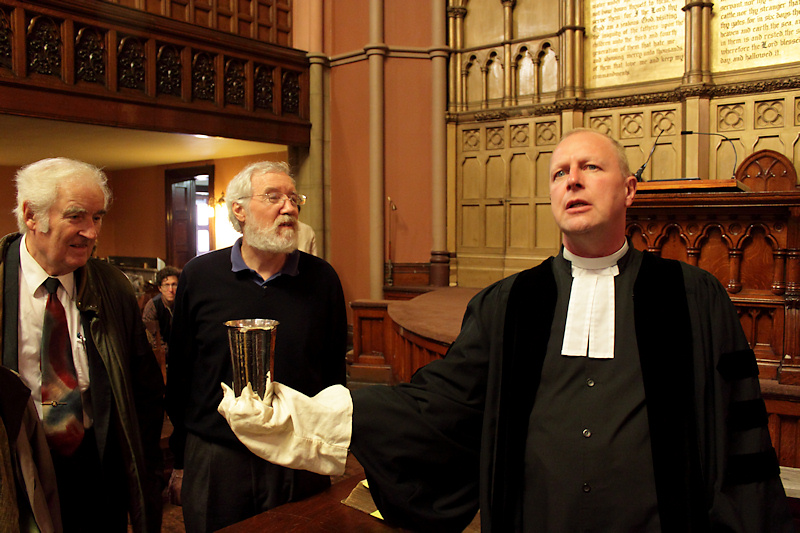
Pastor Meeter shows the communion cup.
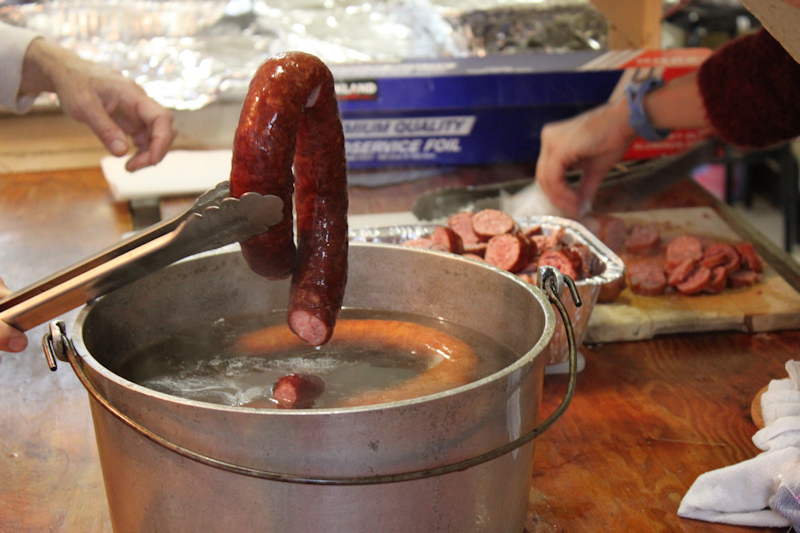
The metworst sausage.
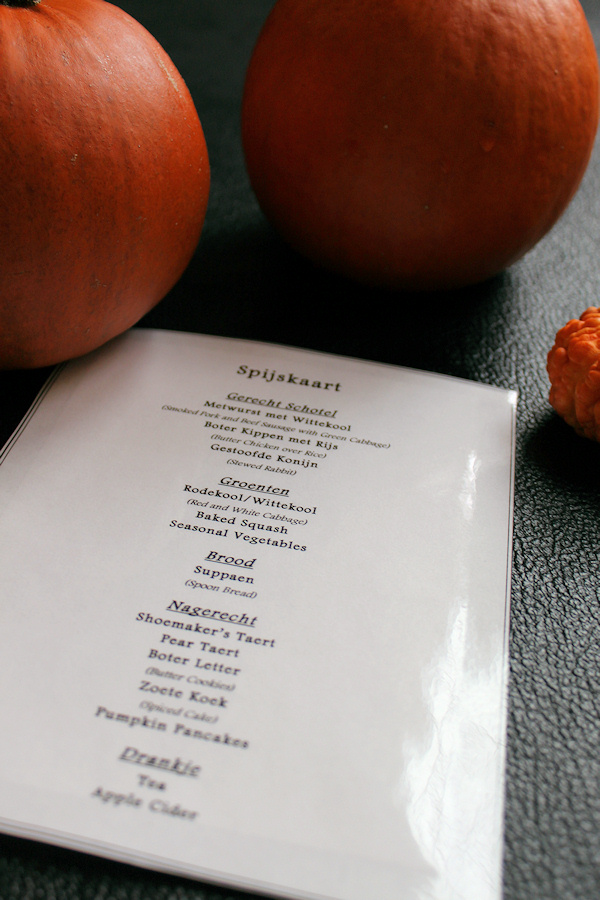
Menu.
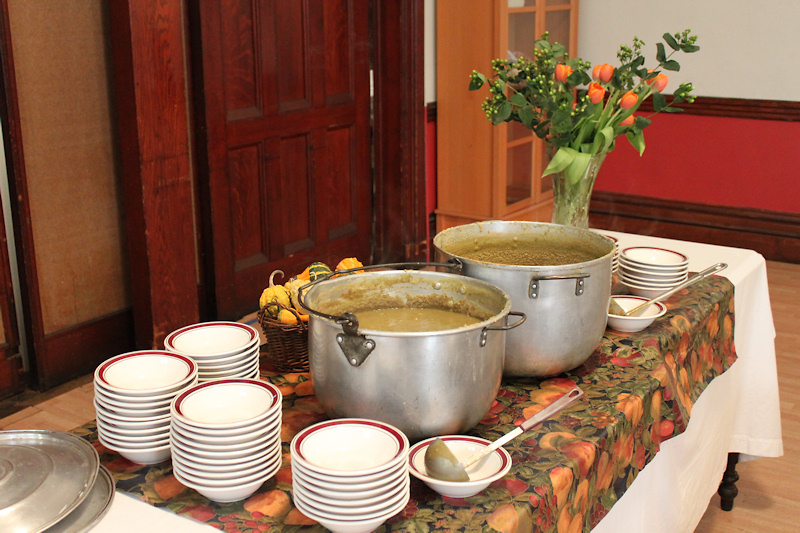
Pea soup, ready for serving.
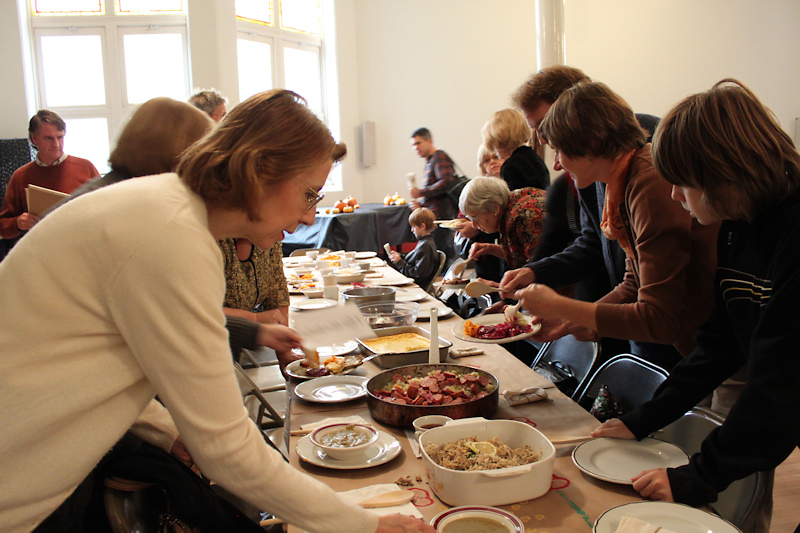
Enjoying the dinner.
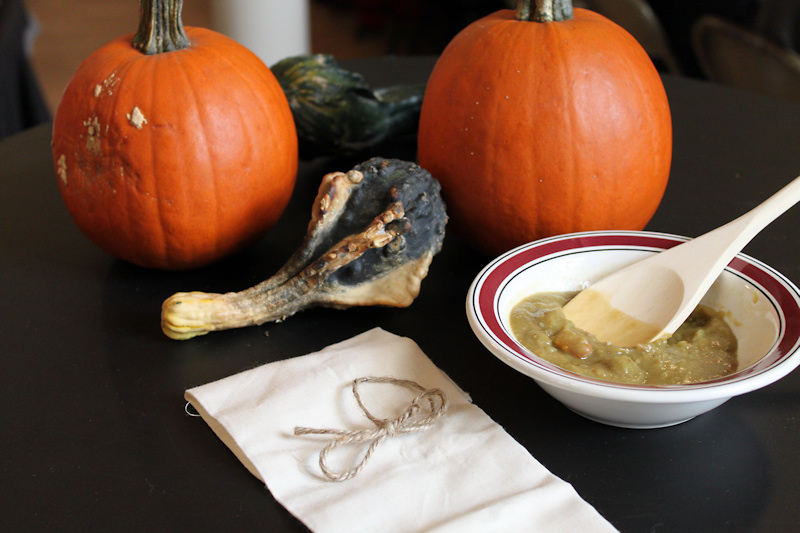
Pea soup with a wooden spoon.
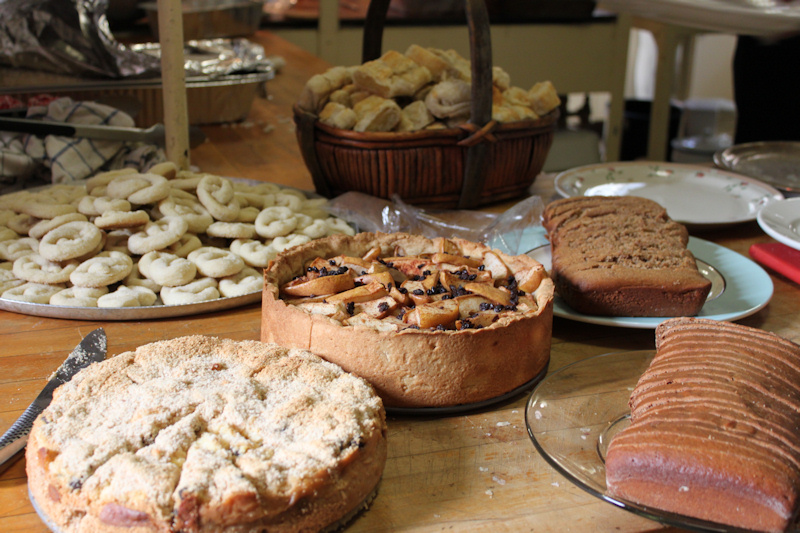
The desserts.

Ken Nieuwenhuis, the event chef.
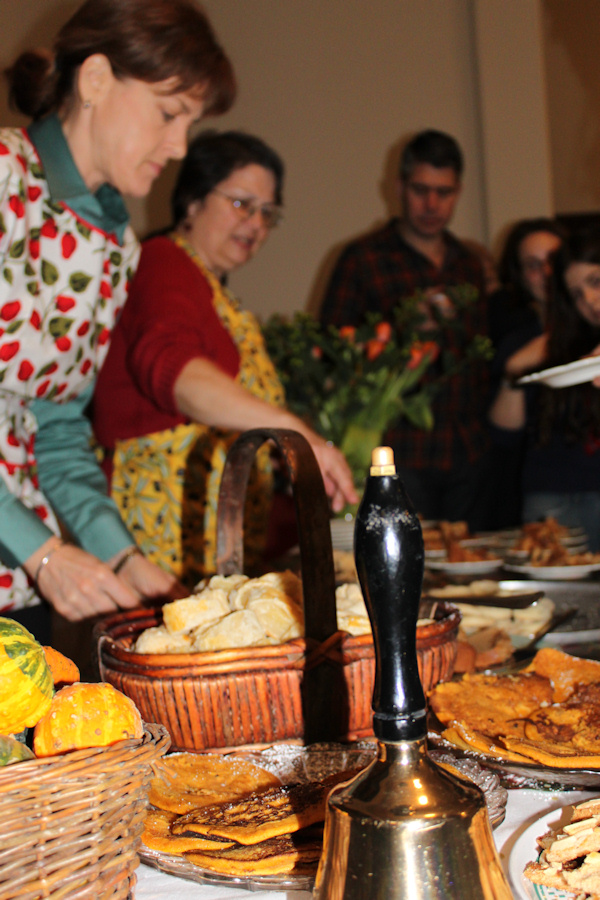
The desserts were popular!
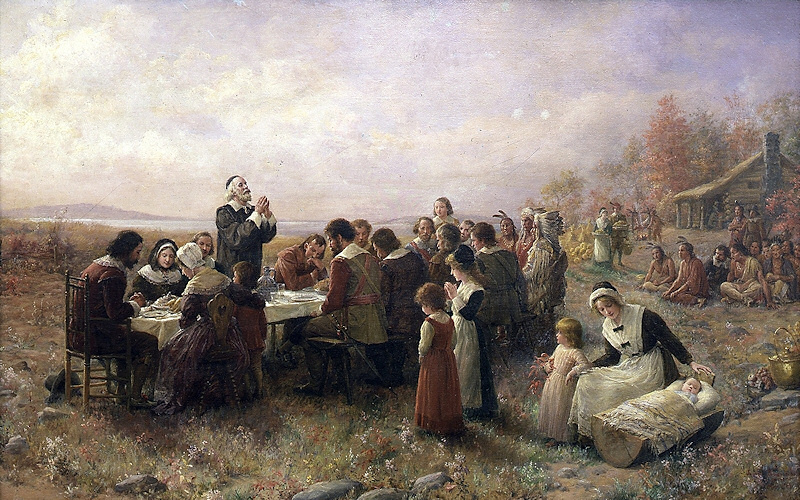
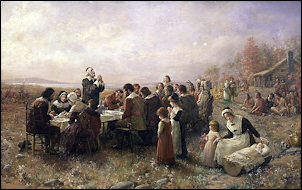 In early autumn of 1621, the 53 surviving Pilgrims of the Mayflower celebrated their successful harvest and that moment is remembered as the