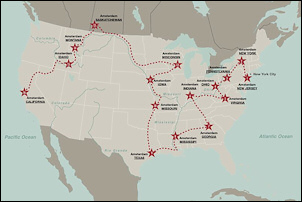
 Amsterdam Stories USA is a road movie in the making by Dutch filmmakers Rob Rombout and Rogier van Eck. The documentary is a portrayal of small-town America that follows the Dutch migratory flow through 16 North American towns, all named Amsterdam.
The filmmakers are making four visits to the States, each in a different season. They are now on their winter trip to "Amsterdams" in Montana, Idaho and California. The 4.5 hour documentary is expected to be released in mid 2012.
Visits to Amsterdam, USA
We caught up with the filmmakers while they were in Nevada. So far, they have visited about half of the 16 Amsterdams they plan to visit. They are on their way to California: "We're meeting standup comedian Sven Amsterdam there, in an Amsterdam bar", says Rombout.
Rombout: "Before we arrive, we try to find a local radio station in the town where we'll work. It gets you introduced to the city, and people start hearing your name. In general, we stick with the local media: local papers, local radios. 'Amsterdam Stories USA' a sort of passport for us. We don't have to go through the whole introduction phase when people know that we are working on this project."
"Everywhere we go, people will at first ask: 'Why film here? There is nothing to film here!' But after a few days stories always come up. We usually focus on one or two characters in each town." Van Eck: "We'll stay four or five days in every place we visit; the rest of time we're on the road. During our travels between Amsterdams we also make portraits of people we meet."
"We're now in the second part of our trip. In our first trip we visited the North East, from Upstate New York to Virginia. Now we're doing the West Coast."
Not looking for clichés
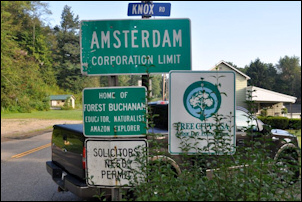 "We're not looking for Dutch clichés like tulips and wooden shoes. The movie is a road movie, with stories of Amsterdam in the USA as a connecting element", explains Rombout. "The only real nostalgic Dutch part will be the beginning of the film, which we shot in the Holland Society of New York."
"It's a trip through the lesser-known America; off the beaten track. We're looking for the interesting, the unusual. The unpredictable is interesting!"
"In this way, our film has a different perspective than a book like 'Holland, USA', which was explicitly looking for Dutch roots in the United States. Film is more emotional than a book, and we tend to focus more on individuals rather than groups. It's a radiography of the small-town America, a road trip through the unknown America."
Stories
Rombout: "The most 'Dutch' Amsterdam we have been so far was in Montana. Many of the founders there were immigrants from Friesland and Groningen. It was a closed, isolated community. The original settlers were deeply religious people.
"I've made several movies about sailing, I like to think of live these little places like on a ship: isolated and far away from everybody. The smaller a place is, the better material for a film it becomes."
Along their journey they stopped in Great Falls, Montana where they met a 19-year-old girl who was working as a barista and talked about her difficult economic situation since the crisis. They filmed her outside in the falling snow as she described her dream of going to Africa to help the people there.
"Our favorite Amsterdam? That would be Amsterdam, Ohio. Number two Montana, or perhaps the one in Idaho. We were there in the middle of the winter — very desolate."
"About 15 people live in Amsterdam, Indiana. When we interviewed the mayor, he got visibly angry about 'those people!' It turned out that he was the only one in the village who participated in the 2010 Census. The official registration of the town was thus 1 person, so now there was no funding."
"This is typical, I think. People in small villages, with a conservative-anarchistic mindset: 'we'll take care of ourselves'. Our movie starts at the East Coast, which is of course more densely populated, and where you'll find the 'human aspect' of things. It ends in the wide open landscapes of the American west."
Movie production
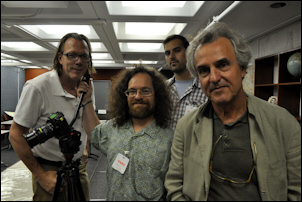 Rombout and Van Eck both live in Brussels, Belgium, and speak French together as Van Eck is born in Paris (from Dutch parents) and speaks better French. They've produced movies in Belgium for almost 30 years. "The Belgian TV and a French film fund are financing us. We didn't get any response from the Netherlands. Perhaps they feel it's a little embarrassing?" They travel through the States with Collin Bannon and Trevor Cohen.
The film will be broadcast on several TV stations back home and on film festivals. Says Rombout: "We're hoping that perhaps we can get the film on PBS in the United States. In addition, we hope to create five or six screenings in or around some of the community's where we've been. We hope that our movie will create some sort of connection between these places."
"The film will be ready in middle of 2012; we're now working on a trial version. We initially signed for a movie of 140 minutes, but we think we'll actually create a film of four to five hours."
The film is part of a trilogy. Rogier and Rob produced "Amsterdam via Amsterdam", to critical acclaim. After 2012, they plan "Amsterdam, Black and White", about New Amsterdam in Drenthe, the Netherlands and Amsterdam in Transvaal (South Africa).
http://www.amsterdamstoriesusa.com
http://www.robrombout.com
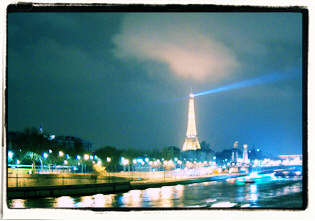 Tonight is the start of our vacation! Sasha is presenting one of her papers at an economics conference in Paris next week, and we're making a nice holiday out of it. Sunday evening we'll leave from Charlotte, NC to Paris and we'll stay for about a week in the City of Light.
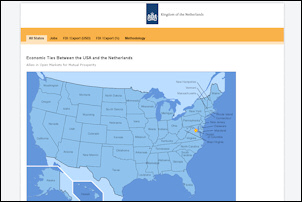 Economic ties with the Netherlands support more than 700,000 American jobs, according to a new report by the Royal Dutch Embassy. Trade and investment between the USA and the Netherlands pay dividends in imports, exports and job creation in both countries.
 Today is Sasha's birthday.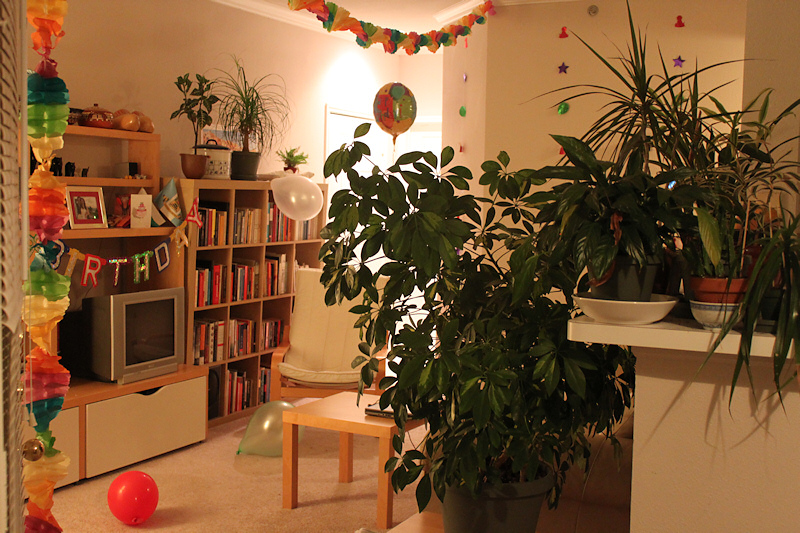
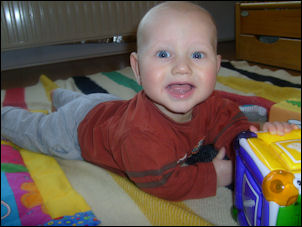 Tomorrow it will be 75 degrees, according to the weather forecast (24 in Celsius). Pretty amazing for February.