 Last week the U.S. Citizenship and Immigration Services (USCIS) introduced a new tool for individuals in the United States to check their own employment eligibility status. This new "Self Check" application is part of the ongoing roll-out of the E-Verify program, which aims to help employers check the employment status of new employees.
This tool will become useful to verify if government records are up-to-date. This is especially important for foreign-born workers, whose employment status may change with transitions between various immigrations statuses.
Employment eligibility verification
E-Verify is an Internet-based program run by the United States government that compares information from an employee's Employment Eligibility Verification Form I-9 to data from U.S. government records. If the information matches, that employee is eligible to work in the United States.
The program was established in 1997 but a government mandate for all federal government agencies to use it per October 2007 significantly increased usage. E-Verify is not without controversy and concerns about privacy and data accuracy have been raised.
From the press release: "E-Verify Self Check, a partnership between the Department of Homeland Security (DHS) and the Social Security Administration (SSA), is the first online E-Verify program offered directly to workers and job seekers. The gives users the opportunity to submit corrections of any inaccuracies in their DHS and SSA records before applying for jobs."
Initially the E-Verify Self Check service is only available to users who maintain an address and are physically located in Arizona, Idaho, Colorado, Mississippi, Virginia or the District of Columbia. In the coming months USCIS will continue to expand the E-Verify Self Check service.
 Our correspondent Noor Speckens visited Vandaag, a restaurant in New York City, to explore how Dutch it is; here is her report.
 Over the years I've become an avid reader of the New York Times. I don't always agree with their commentary, but their reporting and analysis are excellent and I've come to read it several times a day.
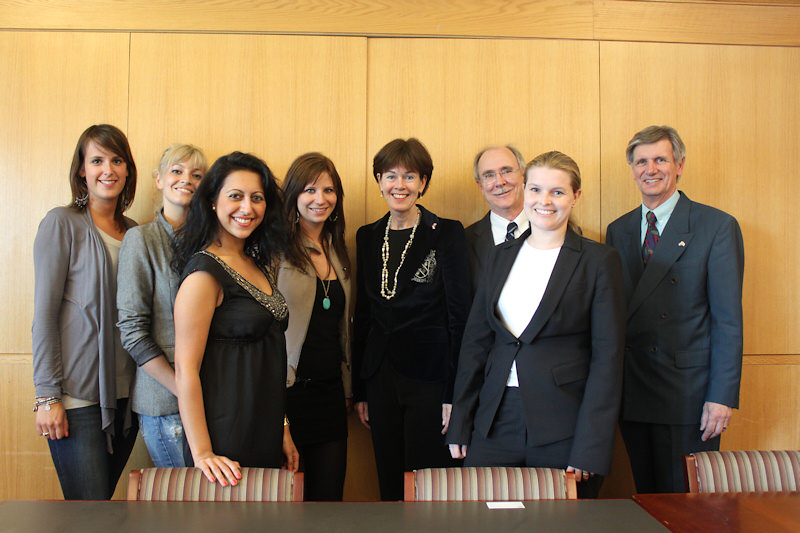
 The Dutch Ambassador to the United States, Renée Jones-Bos, spoke yesterday at UNC's School of Law in Chapel Hill, NC.
 About 35 students and faculty attended the meeting. The UNC School of Law has an exchange program with Radboud University in Nijmegen. Several students from the Netherlands were in attendance.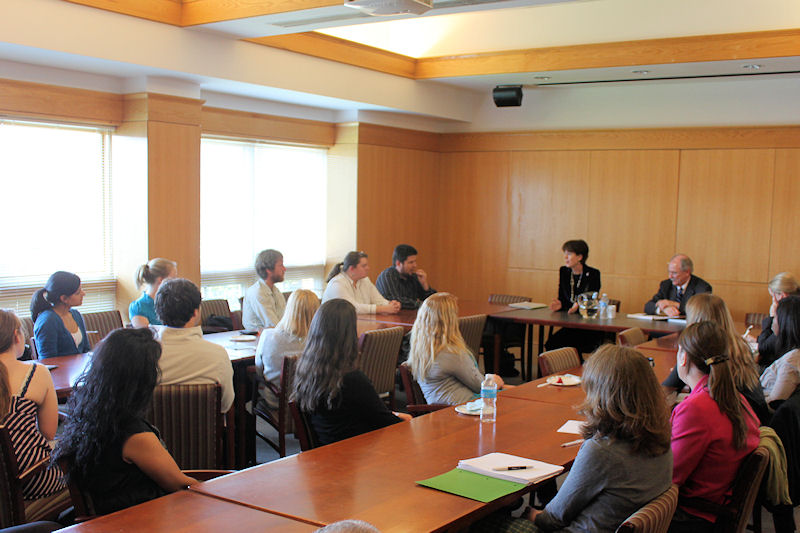

 Yesterday evening we went to the opening reception of a photo exhibition in Cary, NC. The exhibition was with works by Saskia Leary and Laura Holley.
  Today I read 'Uncovering Spoken Phrases in Encrypted Voice over IP Conversations', a very interesting article from the December 2010 issue of ACM Transaction on Information and System Security. (
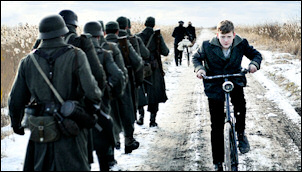 Correspondent Yolanda Gerritsen saw a preview of the U.S. premiere of Winter in Wartime (Oorlogswinter), after the book by Dutch author Jan Terlouw.
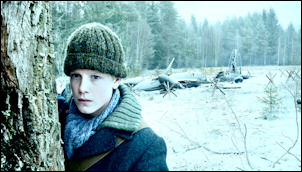 In the ensuing events, Michiel learns the hard way that people around him are not what they seem and that war is not child’s play, but a deadly serious business. In the course of his heroic attempts to get Jack to safety, Michiel is confronted with unbearable personal losses that change him forever. When Jack finally manages to cross the bridge over the IJssel River to Zwolle, 14-year old Michiel has learned life lessons that have made him wise beyond his years.