By Guus , 14 January 2010

People born before 1985 to a Dutch mother and a non-Dutch father may become eligible for Dutch citizenship. The Dutch House of Representatives, de Tweede Kamer, approved a motion today and Justice Minister Ballin will take the measure into consideration.

While children born to a Dutch father and foreign mother have always been eligible for Dutch citizenship, people born before 1985 to a Dutch mother and a foreign father are not. This strange distinction was a legacy from an old law from 1892, which was revised in 1985. Since January 1, 1985 children born to either a Dutch mother or a Dutch father have been eligible for a Dutch passport.

There was a grace-period in the late 1980's where people in this situation could apply for Dutch citizenship but this did not reach everybody on time. The ministry of Foreign Affairs describes the existing regulations for people in this situation (in Dutch).

The proposal is part of a larger overhaul of the law on Dutch citizenship, including more measures to prevent dual citizenship and additional rules to revoke citizenship of terrorists in certain cases. More information on this proposed change and others on the website of the Dutch House of Representatives.

Update: this law will go in effect on October 1st, 2010. Read more about it.

Topic
By Guus , 11 January 2010

On Sunday I went for a run in a park near our apartment, Six Mile Run. A gorgeous run.

For fun I sent an SMS text to someone in the area: 'haha, do you think there are bears here'. The reply: 'it's where the state releases bears, yes'. Hmmm.

When I came home I saw this letter, from 2005: http://www.franklintwpnj.org/bear_release.html: "...released a 240 pound black bear...".

Topic
By Guus , 11 January 2010

Cool demonstration of the possibilities of SixthSense by Pranav Mistry, its inventor.

TED talk

(thanks Mark).

Topic
By Guus , 7 January 2010

Anchor.On February 2, 2010, the India House Foundation will open Ships, Explorers and the World Trade Center, a new exhibition featuring discoveries, artifacts, and multimedia that illustrate the maritime history of downtown New York.

Highlights of the exhibition include:

  • The charred remains of a ship's bow excavated in 1916, long thought to be the ship's keel of Dutch explorer Adriaen Block's ship Tijger, which burned off Manhattan in 1613, and a bronze cannon marked "VOC," property of the Dutch East India Company
  • An ancient, 11-foot iron anchor hoisted from the construction site of the World Trade Center in 1967, where it had been buried for more than 300 years (Courtesy National Maritime Historical Society)
  • Documentary film footage from 1916 of the discovery of the Ship Tijger keel and a section of Manhattan Company Water Pipe (1800) found during excavation for the IRT subway tunnel at the future World Trade Center site (Courtesy Brooklyn College Archives)
  • A model and film of the USS NEW YORK, the Navy's newly commissioned (7 November 2009) Landing Platform, Dock Warship, made with 7.5 tons of World Trade Center Steel forged into its bow (Courtesy USS NEW YORK Commissioning Committee)
  • At the entrance to The India House: a steel artifact recovered from the World Trade Center. This will be a permanent reminder of the World Trade Center, the innocent victims, and the bravery of those who responded on September 11, 2001

"The India House is the perfect setting for this historic exhibition," commented Margaret Stocker, IHF Trustee and curator of the exhibition. "The land at One Hanover Square was owned in 1673 by Peter Stuyvesant's nephew and New Amsterdam's secretary, Nicholas Bayard, and the current building dates to after the Great Fire of 1835."

The India House Foundation was established in 1999 to document and preserve maritime history and help revitalize Lower Manhattan, New York City.

Ships, Explorers and the World Trade Center, India House, One Hanover Square, New York City
February 2-28, 2010
www.indiahousefoundation.org.

Anchor.

An ancient, 11-foot iron anchor hoisted from the construction site of the World Trade Center in 1967, where it had been buried for more than 300 years (Courtesy National Maritime Historical Society).

Mrs. Stocker:

"Archaeologists do not agree on how old this anchor is or where it was made. Did it once secure a Dutch explorer or trader’s ship at the anchorage that early maps show was located off the beach on the Hudson River where the World Trade Center would be built centuries later? Was it made in a Spanish foundry, used on a Conquistador’s vessel, and plundered by a Dutch or British privateer? Was it used on a British vessel before the American Revolution?

This 11-foot anchor was discovered in 1967 when construction workers dug down through landfill and river sand to bedrock in order to ‘anchor’ the World Trade Center Towers. They had secured the anchor in the sub basement of Tower Two when terrorists exploded a bomb nearby it – it survived. In 1999 the Port Authority of New York and New Jersey gave preservationists Kent Barwick and Peter Stanford permission to remove the anchor for research and conservation. On September 11, 2001, the “World Trade Center Anchor” was stored in a shipping container in Peekskill, New York, under the guardianship of the National Maritime Historical Society."

Topic
By Guus , 5 January 2010

Geert Snoeijer's photo exhibition in Amsterdam City Hall.From our correspondent in the Netherlands, Jaap Bosman.

On December 14, 2009 an exhibition of portraits by Geert Snoeijer of members of the Holland Society of New York was opened for the public. The photos are on display in a corridor in the town hall of Amsterdam, next to the opera hall (Muziektheater). The opening was attended by about 200 people, including several members of the Holland Society who were in Amsterdam to see the display with their portraits. We met Bromme H. Cole, Stephen Van Ness, Walton Van Winkle III, dr. Andrew A. Hendricks, James R. Van Wagner and Peter G. Ten Eyck II.

The Holland Society in New York was founded in 1885 to collect information about the settlement and history of New Netherland. Members of the Holland Society of New York are males who are a descendant of an ancestor who lived in Nieuw Nederland before or during 1675. A Genealogy Committee will study ones application for membership.

Mr. Snoeijer took the pictures of the members of the Holland society in the style of 17th century Dutch Masters to create a connection between the descendants on the photo and their 17th century ancestors. Each photo shows objects that tell part of the subject's story. Robert Quackenbush, an author and illustrator of children's books, is pictured with painting equipment, brush and palette. The photo of James R. Van Wagner shows a picture of a soldier, a reminder of the military history of his forefathers. In portraits of the old Dutch masters one always sees such objects.

Opening
Mr. Krans, a friend of Geert Snoeijer, announced Carolien Gehrels, Alderman for Arts and Culture of Amsterdam. She likened the photos of the members of the Holland Society Of New York to paintings of the Dutch masters such as Frans Hals and Rembrand. Martine Gosselink, Head History Department of Rijksmuseum, spoke about the first inhabitants of Nieuw Amsterdam, for instance Catalina Trico and her friend Joris Rapalje. After the lecture of Martine Gosselink the exhibition was officially opened by Julie A. Ruterbories, Consul General of the United States.

Curator Martine Gosselink was very much involved in American-Dutch history and visited New York. She is a friend of Mr. Snoeijer and she told him about the Holland Society, about these men being very proud of their Dutch roots. Mr. Snoeijer: "I wanted to make the portraits of these men". Mr. Snoeijer visited the Holland Society and photographed society members. He had this question in mind: "Can you still see their heritage in their facial features? Donald Westerveld for example, traces his heritage to the village of Westerveld in Drenthe, and you can still see that in his features. In his face I also see the features of a Native American. "

"Pictures as images of the soul"
The exhibition shows 23 portraits. Mr. Snoeijer tries to make his images reflect the soul of its subjects: "That's the best part of this work; pictures as images of the soul. I use a a ZONE VI view camera, a technical camera, and when taking an image I have a dark cloth over my head, like a photographer from the good old days".

"I would have preferred to photograph them at their homes but this was impractical since the members live throughout the United States, so we met in New York. I've been to New York five times now, every time scheduling a day for portrait sessions, 1.5 hours per session."

When Mr. Snoeijer met Robert Quackenbush for a photo session they became friends. "Robert and I both see the world in pictures, he being a painter, I being a photographer". Mr. Snoeijer asked if Mr. Quackenbush would mind posing before an oil painting of Mr. Quackenbush's illustrious ancestor Wyn Quackenbush Mabie. "No way!" said Mr. Quackenbush jovially. "She had her turn. Now it's my turn! I'll let you take a portrait of me with your camera if you let me paint an oil portrait of you at the same time!" It was agreed, and Mr. Snoeijer's portrait is now visible in the photograph of Mr. Quackenbush.

A selection of the portraits can be seen on Geert Snoeijer's website.

Geert Snoeijer
Mr. Snoeijer was born 1968 in IJsselmuiden, the Netherlands. Following a brief career as a lawyer in Brussels and Amsterdam, he became an assistant to creative photographer Emilio Brizzi and a year later he joined the Amsterdam newspaper Het Parool. Nowadays his work, which focuses on portraits and stories, is published in numerous national and international media.
Mr. Snoeijer has a very positive impression of New York and the people of the city, this was his first visit to New York and the USA. "The idea of the photographs was well received and people were full of energy when making the picture. It's like anything is possible in New York, there is so much enthusiasm for new things! People were very cooperative and getting things prepared for the picture sessions went smoothly".

This is Mr. Snoeijer's first great exhibition with an opening party and he is very pleased with the number of people that attended. He would like to continue the portrait series, and is considering publishing a book. There are no definite plans yet to display the exhibition in the United States.

The Holland Society of New York, exhibition by Geert Snoeijer.
December 14, 2009 through January 10, 2010 in Amsterdam City Hall/Stopera
January 12, 2010 through February 19, 2010 in World Trade Center Amsterdam
http://www.geert-snoeijer.com/

Art in front of Amsterdam City Hall.

Art in front of Amsterdam City Hall.

Geert Snoeijer's photo exhibition.

Photo exhibition in Amsterdam City Hall.

Pete G. Ten Eyck II in Amsterdam.

Pete G. Ten Eyck II in Amsterdam.

Topic
By Guus , 3 January 2010

The Consulate General of the Netherlands in California will open its new office in the One Montgomery Tower in San Francisco tomorrow, January 4.

The Consulate's old office in Los Angeles will remain open at the current location on Wilshire Blvd., servicing passport and visa applications and War Victims Department (WUV) clients.

From the press release:

With the move to San Francisco, the Consulate will further enhance its presence in the Western United States, leveraging strong local networks in water management, climate change, biotech, nanotech, new media/gaming, and IT. The new location will also benefit the Consulate by virtue of its close proximity to Sacramento.

The new office in San Francisco will be the base of activities for the Dutch government in the Western United States. The Consulate’s Consular, Economic, and Press & Culture departments, which will move from Los Angeles, will be joined in San Francisco by representatives from the Netherlands Business Support Office (NBSO), the Netherlands Foreign Investment Agency (NFIA), and the Netherlands Office for Science & Technology (NOST), who are moving to San Francisco from San Mateo.

"With the move, we bring together a strong team," says Consul General Bart van Bolhuis. "United in San Francisco, we strengthen our presence not only locally, but also beyond the Bay Area. In fact, we will remain active in Los Angeles with our cultural and economic activities. It is helpful, therefore, that we will keep our office on Wilshire Blvd."

Since December 16, 2009 the Honorary Consulate in San Mateo is closed. More information on the move and contact information on the website of the Consulate.

Topic
By Guus , 2 January 2010

We walked through Princeton, New Jersey this afternoon. Princeton, famous for its university, is 30 minutes away from Somerset and it's a cute little place with high-end shops and restaurants.

From there we drove to Bridgewater Commons and, after dinner, home. It was very cold today, and I bought a cap for running in this weather.

Topic
By Guus , 29 December 2009

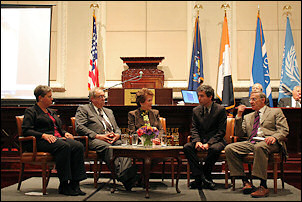
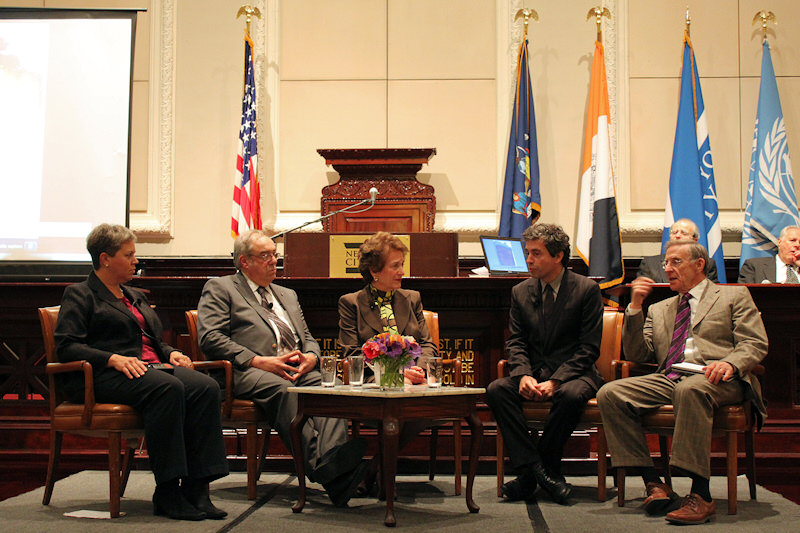
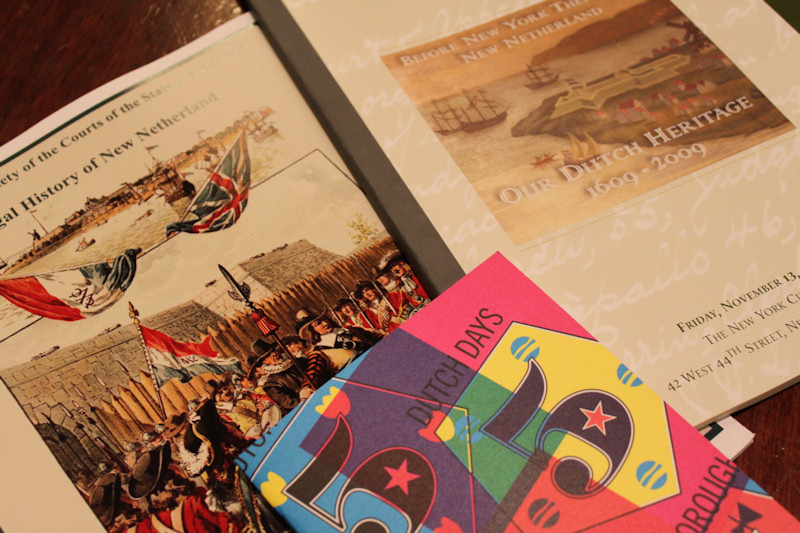
The panel. The Historical Society of the Courts of the State of New York participated in the 5 Dutch Days by presenting its annual Stephen Kaye Memorial Program entitled: Before New York There Was New Netherland, Our Dutch Heritage 1609-2009. The event was held on November 13th at the New York City Bar and featured a round table discussion with writers and scholars Russell Shorto, Dr. Charles Gehring and Jean Zimmerman.

"What's the fuzz about the Dutch?"

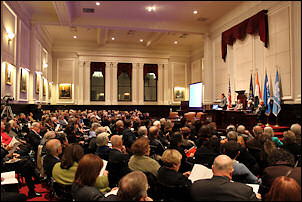
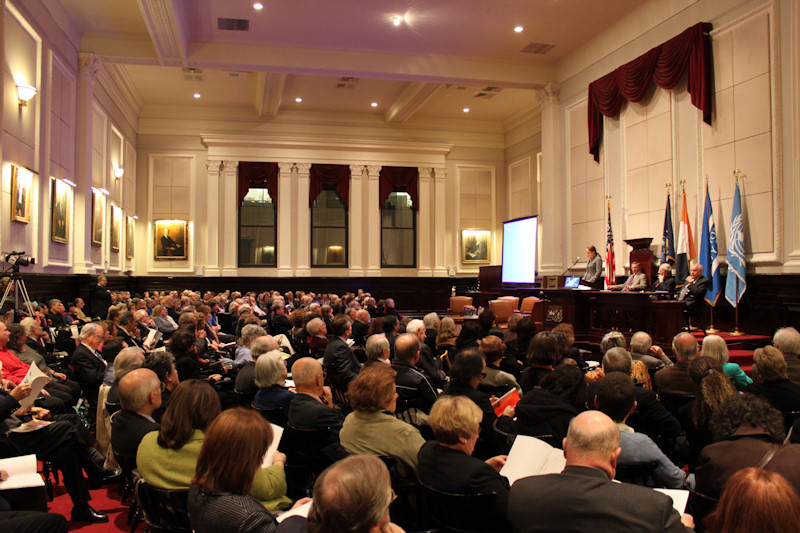
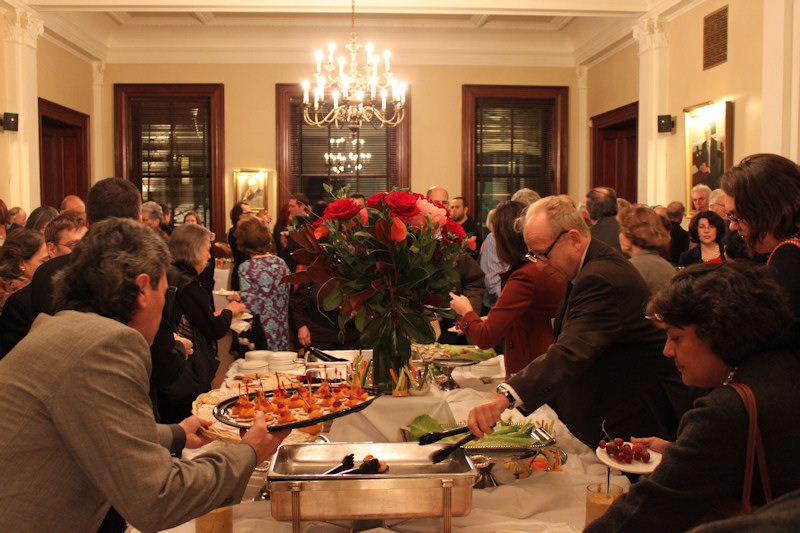
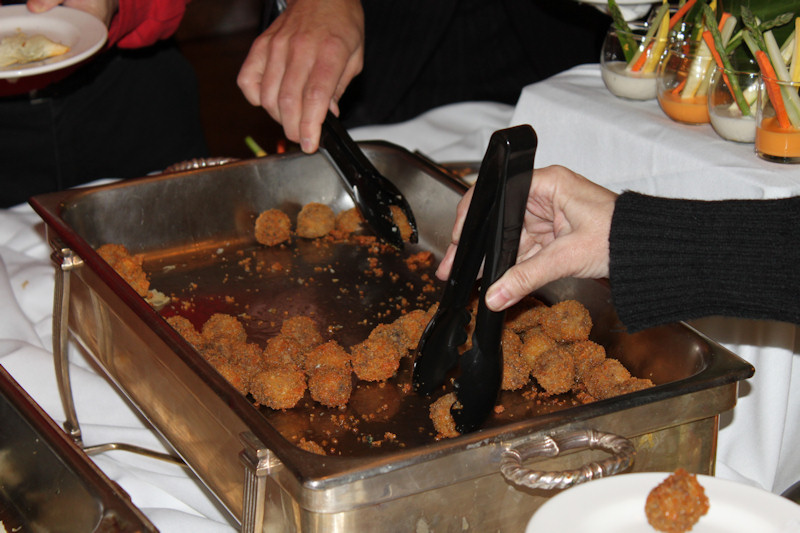
The evening started with a reception in a stately hall at the New York Bar, in the heart of Manhattan on West 44th Street. There were bitterballen, Dutch snacks, and Dutch beer. According to the organization, close to 400 people were in attendance, many participating because of the 5 Dutch Days, and many more from the legal and educational community who are members of the host Society.

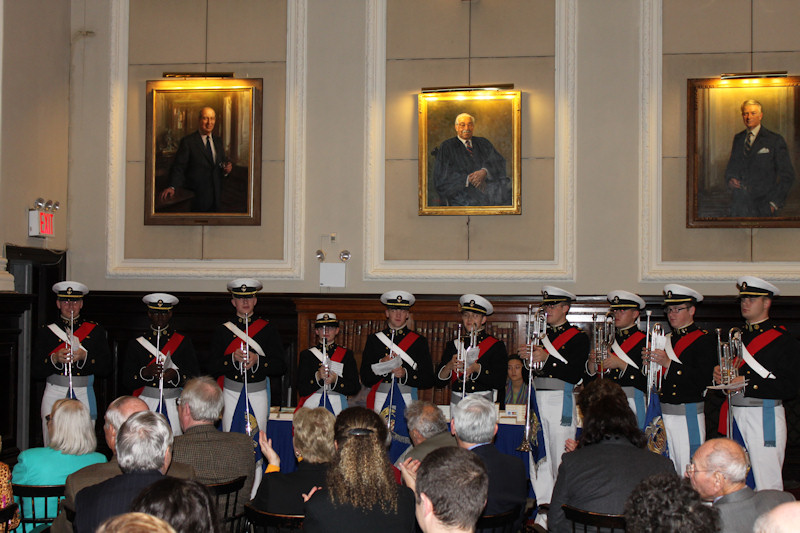
The U.S. Merchant Marine Academy Fanfare, presented by The Society of Daughters of Holland Dames, alerted everyone to the beginning of the program and played the national anthem. The official program began with a welcome by New York State Chief Judge Jonathan Lippman. The evening was sponsored by the firm of Proskauer Rose LLP in combination with the Holland Society of New York.

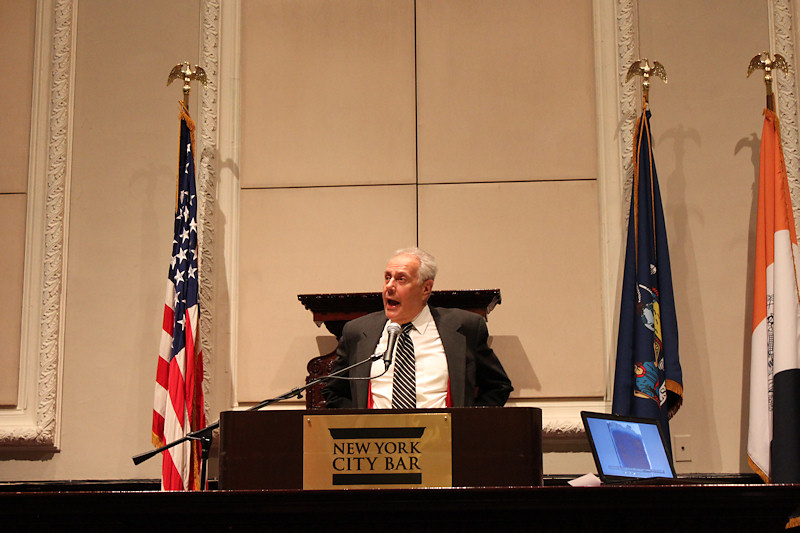
Hon. Albert Rosenblatt provided an introduction to the evening's program, and gave a geopolitical background of the Dutch colony in the 1600's. "Henry Hudson sailed onto the river now carrying his name and like many others, decades later, got stuck in Albany".

There was a reading by Henry Miller of the 1657 Flushing Remonstrance, a plea for religious freedom. This document, which is now in the collection of the New York State Archives makes the case that liberty extends to all. Mr. Miller's rendition in his rich baritone voice was quite impressive.

Round table discussion

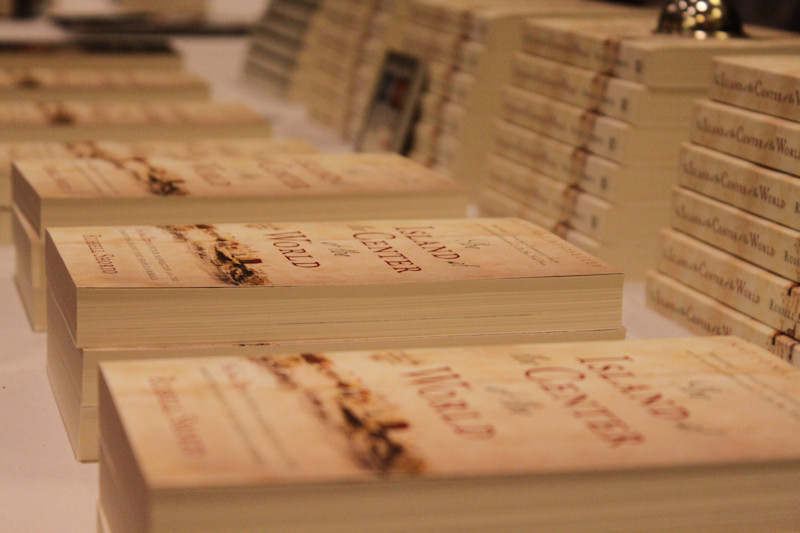
The main program of the evening was a round table discussion with Dr. Charles Gehring, Russel Shorto and Jean Zimmerman on the importance of New York's Dutch heritage in shaping its democratic process. Russell Shorto is the author of The Island at the Center of the World, the best-selling book whose title gives rise to the South Street Seaport Museum exhibit’s name; Dr. Charles Gehring, noted director of the New Netherland Project at the New York State Library, where the archives of the Dutch colony centered on Manhattan are being translated and Jean Zimmerman, author of The Women of the House: How a Colonial She-Merchant Built a Mansion, a Fortune, and a Dynasty.

The discussion was moderated by former Chief Judge Judith S. Kaye and Hon. Albert M. Rosenblatt. Chief Judge Kaye posed the main question: "Tonight we even had fanfare. What's the fuzz about the Dutch?"

The audience.Russell Shorto: "The influence of the early colonists on American society was profound. In New Netherland, tolerance was a glue to keep society together. Combined with capitalism and lots of minorities this set the tone for the future culture of the US". Dr. Charles Gehring added: "Only 50% of the immigrants in New Netherlands were ethnic Dutch. It was a true multi ethnic society -- this is unique to New Netherlands. The English and French were groups with a single ethnicity. New Netherland included immigrations from Croatia to Lithania to Scandinavia."
Jean Zimmerman spoke on the role of women in the colonies. She writes of Margaret Hardenbroeck who, in a man’s world, rose to become a tycoon in New Netherland. Mrs. Zimmerman points out that Dutch law offered women “a measure of invincibility.” She notes that Holland’s legal system, transported to these shores and lost after the British takeover in 1664, “was fairer to women than any other in Europe. The Dutch were very open to have women in different positions in society. Dutch men saw women as successful and dominant and accepted that."

It was an interesting discussion, brought with humor at times. Dr. Gehring: "Buying Manhattan from the Indians for a pittance? It's a romantic story. The numbers that circulate have not even adjusted for inflation". Chief Judge Kaye quickly added: "like judges' salaries!".

Marilyn Marcus, Executive Director of the Society, declared the program a great success, and noted that the Society was deeply honored to participate in this remarkable quadricentennial celebration of Dutch-American heritage.

A publication written by Frances Murray, the Chief Legal Reference Attorney of the NY State Court of Appeals accompanied the event. "A Legal History of New Netherlands" is available on-line.

Reception.

Bitterballen, a Dutch snack.

The U.S. Merchant Academy’s Fanfare Trumpets.

The audience.

Henry Miller reading the Flushing Remonstrance.

The panel.

The panel.

The Island at the Center of the World.

Materials.

Topic
By Guus , 27 December 2009

We arrived around 1.00 am in Somerset last night, after a smooth flight. What a beautiful island Aruba is! Great beach, great weather.

We brought home Dutch cheese, a cheese grater (kaasschaaf) and a sun tint. When we got home we heard from the crew about the foiled attack on an aircraft flying from Amsterdam to Detroit yesterday.

No need for sunblock here but at least it's not snowing.

Topic