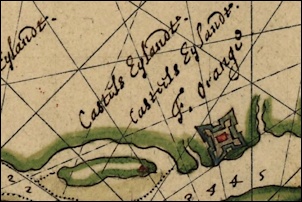
 The remains of the historic Dutch fort near Albany, Fort Nassau, are threatened by a proposed new oil facility. Fort Nassau, which is named after the Dutch royal family, was built in 1614 and was the first Dutch settlement in America.
The proposed oil plant will be built in the general vicinity of the 400 year old fort and there is a great risk that the fort will be destroyed forever. However, there is hope that an archeologically sound compromise can be reached -- provided that the city of Albany steps in.
The most important European archaeological site in North America
"This is probably the most important European archaeological site in North America," said historian, author and archaeologist Don Rittner. "Right now in January, 400 years ago, the Dutch were building Fort Nassau. This structure represents the first real presence of the Dutch in North America, but there is a chance it could be destroyed.
Fort Nassau was constructed during a 1613 trading expedition for the Amsterdam Van Tweenhysen Company, commanded by Captain Adriaen Block. In January 1614, Block remained in New York Bay but sent Hedrick Christiaensen and his crew up the Hudson River (then called the "North River") to build a trading post, named Fort Nassau.
The fort was located on "Castle Island," which has since gone by several other names and was later buried under silt and earth. Fort Nassau became the focal point for the North American fur trade in the Northeast, where the Dutch and indigenous Mohicans traded goods for fur. It also became the staging point for expeditions to seek out mineral deposits and other natural resources for exploitation.
After several washouts by the Hudson River spring floods, and a final severe flood in 1617, the Dutch moved on to the mainland and built Fort Orange, which in 1970 was partially excavated before an exit from I-787 was placed on top of it.
Today, Global Companies plans to build a facility to heat crude oil at the Port of Albany in the general vicinity of where Albany historian and cartographic sleuth John Wolcott has determined that the original Fort Nassau is located. Wolcott was responsible for finding the remains of the original Fort Orange in the early 1970s.
"John Wolcott is very good at reading old maps, old measurements, old triangulations," Rittner said. "If John tells you something's in the ground, I'll put money on it."
Not the first time
This is not the first time a historic Dutch building is damaged -- in the 1970's a highway was built over the remnants of Fort Orange, the successor to Fort Nassau. "That was so stressing and hurtful to me, personally and publicly," Wolcott said of the loss of Fort Orange. "Fort Nassau wasn't a permanent settlement, but it was the beginning of it all here in the Northeast. Let's finally save one."
Global Companies, a unit of Global Partners, based in Waltham, Mass., plans to build a 2,600-square-foot facility at the port's rail yard to heat crude as it is pumped out of rail cars and into storage tanks. The oil will then be shipped out on barges headed downriver toward refineries on the east coast.
The proposed boiler plant will have to be reviewed by the Albany Planning Board, and will be subject to an archaeological review. If handled correctly, with sensitivity to the historical importance of this structure, a compromise could be achieved that would save the fort, Rittner said.
"If they find this fort, you can preserve it," Rittner said. "You can design the plant so that it incorporates the fort into the site plan. You can display any artifacts in a structure on site, or move them to the museum. But you can also expose part of the fort for the public to go see. This is located in a place that is easily accessible to the public and near a public park."
More information and a call to action can be found here.