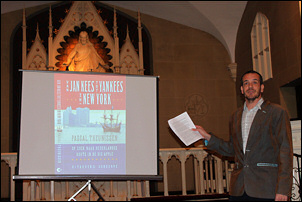
 Yesterday was the start of 5 Dutch Days, a series of events around Dutch-American Heritage Day. In the Our Saviour’s Lutheran Church in Bay Ridge, Brooklyn, NY the Scandinavian East Coast Museum presented two speakers on Dutch New York and Scandinavians in Dutch New York.
The Scandinavian Museum has the goal to establish a permanent museum recognize the contributions and stories of immigrants from Denmark, Iceland, Norway and Sweden to the United States.
The first speaker, Pascal Theunissen, is a journalist and Dutch national. When he moved to New York he was inspired by Russell Shorto's book about New Netherland to start looking for traces of Dutch history in New York. His book, Van Jan Kees tot Yankees, was published earlier this year. While he didn't immediately realize that 2009 would be the year to celebrate 400 years of Dutch-American relationships, it obviously fits in nicely in this year's theme and it the book received positive reviews in the Netherlands. His book is currently not on sale in the United States; it is available in Dutch in bookstores in the Netherlands and on-line. (Disclosure: we received a free copy of the book to review).
Mr. Theunissen provided a lively introduction to the history of New Netherland, and the role of the Dutch in New York's early history. Keeping in line with the evening's theme of Dutch-Scandinavian relations he described how Dutch Governor Peter Stuyvesant moved an army to New Sweden in 1655 and captured the Swedish colony. Mr. Stuyvesant clearly did not come to Manhattan to make any friends.
Dutch millstones in the pavement
Mr. Theunissen gave a number of examples from his book of Dutch places in New York, such as the Voorlezer's House, the first school in the United States, and the Wyckoff House in Brooklyn. He also mentioned 17th century millstones in the pavement in Queens, Sinterklaas' influence on Santa Claus and the game 'double Dutch'. "New Amsterdam is long gone but there are signs all around you". The most remarkable is the Brooklyn's slogan: Eendraght Maekt Maght -- strengh in unity, in old Dutch.
Bergen Street and beyond
The second speaker, Victoria Hofmo, is the driving force behind the Scandinavian East Coast Museum and President of the museum. Ms. Hofmo introduced the history of Scandinavians in the 17th century. Against a background of internal conflict in Scandinavia, war, unfavorable inheritance laws and a massive loss of population due to the black plague many people from Norway moved to Amsterdam, and later to the New World. Scandinavians around New York often blended in to the Dutch culture and even used the Dutch language. A nice example of a Dutch-Scandinavian relation is the story behind the Bergen Street and Bergen Place -- named after a Norwegian-Dutch/French couple.
Only a few people in the audience were Dutch; most of the people attended had a Scandinavian background. Ms. Hofmo explained that the long common history between the Dutch and the Scandinavians encouraged the Scandinavian Museum to start participating in 5 Dutch Days a few years ago.
After the official program there were drinks and Dutch and Scandinavian cheeses as well as herring, a treat in both Scandinavia and the Netherlands. A highlight for your correspondent was the plate with marzipan and Swedish cookies that were very similar to speculaas.
Scandinavian East Coast Museum
http://www.scandinavian-museum.org
Van Jan Kees tot Yankees, Pascal Theunissen
http://www.pascaltheunissen.com
Mr. Theunissen will be in the library in Alkmaar, the Netherlands on November 22.
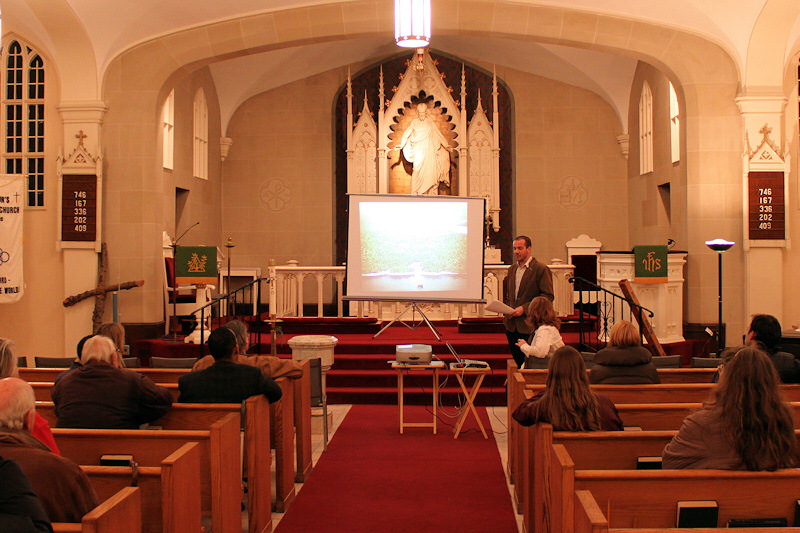
The presentations were in a beautiful church room.
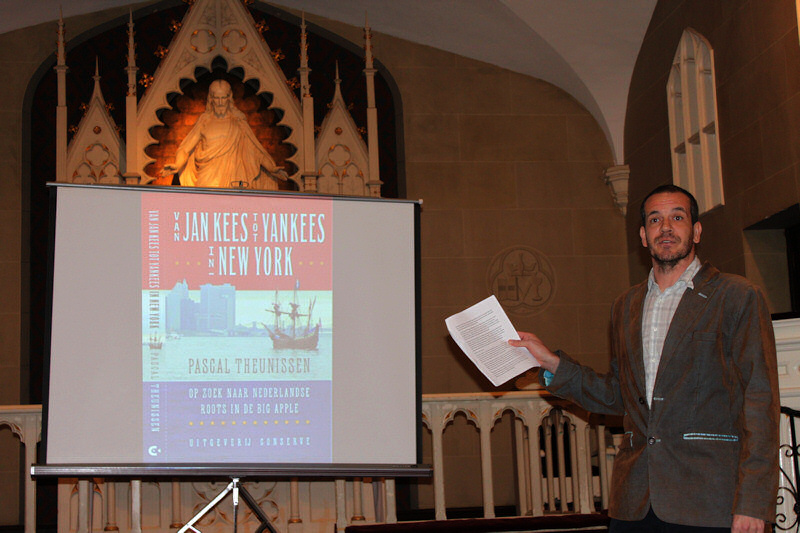
Pascal Theunissen: "Van Jan Kees to Yankees".
Victoria Hofmo: "Scandinavians in Dutch New York".
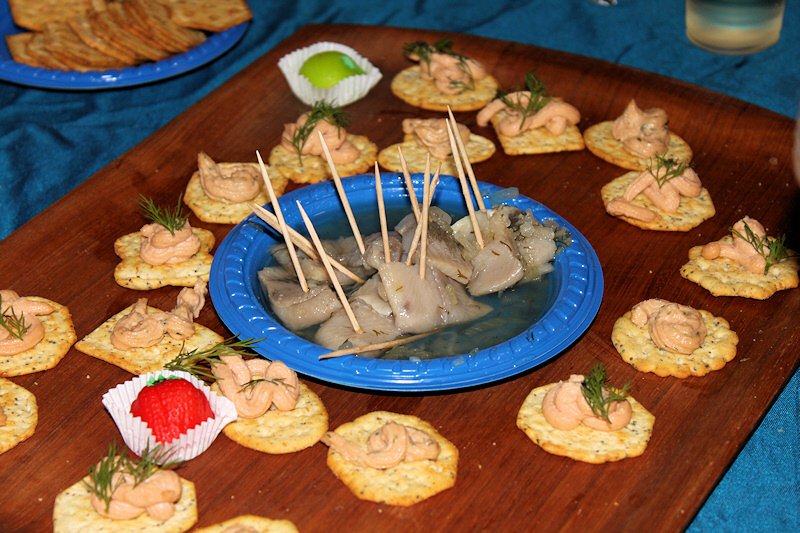
Herring.

Another Dutch-Scandinavian connection: Swedish cookies that taste exactly like Dutch speculaas.